
The Return of Xander Cage is Sensory Friendly at AMC Tomorrow
Last updated on January 27th, 2017 at 03:25 pm
AMC Entertainment (AMC) has expanded their Sensory Friendly Films program in partnership with the Autism Society. This Tuesday evening, families affected by autism or other special needs have the opportunity to view a sensory friendly screening of xXx: The Return of Xander Cage, a film that may appeal to older audiences on the autism spectrum.
As always, the movie auditoriums will have their lights turned up and the sound turned down. Families will be able to bring in snacks to match their child’s dietary needs (i.e. gluten-free, casein-free, etc.), there are no advertisements or previews before the movie and it’s totally acceptable to get up and dance, walk, shout, talk to each other…and even sing – in other words, AMC’s “Silence is Golden®” policy will not be enforced during movie screenings unless the safety of the audience is questioned.
 Does it make a difference? Absolutely! Imagine …no need to shhhhh your child. No angry stares from other movie goers. Many parents think twice before bringing a child to a movie theater. Add to that your child’s special needs and it can easily become cause for parental panic. But on this one day a month, for this one screening, everyone is there to relax and have a good time, everyone expects to be surrounded by kids – with and without special needs – and the movie theater policy becomes “Tolerance is Golden“.
AMC and the Autism Society will be showing xXx: The Return of Xander Cage tomorrow, Tuesday, January 24th at 7pm (local time). Tickets are $4 to $6 depending on the location. To find a theatre near you, here is a list of AMC theatres nationwide participating in this fabulous program (note: to access full list, please scroll to the bottom of the page).
Coming Later in January: Monster Trucks (Sat, 1/28)
****************************************************************************************************************************
Editor’s note: Although xXx: The Return of Xander Cage has been chosen by AMC and the Autism Society for a Tuesday Sensory Friendly screening, we do want parents to know that it is rated PG-13 by the Motion Picture Association of America for extended sequences of gunplay and violent action, and for sexual material and language. As always, please check the IMDB Parents Guide for a more detailed description of this film to determine if it is right for you and your family.
Teen Suicide: How to Explain Your Grief to Your Child
Last updated on January 27th, 2017 at 03:25 pm
My son is now fourteen and a Freshman in High School. Within months of starting the new school year, his high school marching band community suffered tragedy: the suicide of one of its members. And despite the large number of kids in the band – this tragedy was close. The boy who died, Patrick, was the head of my son’s instrument section.
 I didn’t know Patrick well, but the impact of his death on me was surprising. Both the fact and the nature of it were a profound shock when I first heard about it – via text from my son when he arrived at school one Friday morning.
The next several days were a painful procession of events and rituals: gatherings at homes of the kids, a candlelight vigil at the school stadium where the band regularly practiced, visitations and funeral mass at the local Catholic Church.
I was concerned for my son, but I was also in pain. I cried a lot. I wanted to know what happened. I wanted to know “why?” I kept picturing Patrick at practices. He was extremely alive, outgoing and very good looking. None of this should matter, but somehow it did. When we learned he had shot himself in a moment of despair over getting in some trouble, I thought about his parents. I was sick at the thought. I was also angry. Angry that he thought this was his only option. Angry that he had access to a gun.
My son was surprised by my grief. He kept saying that I hardly knew Patrick, and he didn’t expect me to want to attend the various gatherings. I began to feel that he might think I was “muscling in” on a situation that was personal to him. Certainly he and the others in his small instrument section were closing ranks and I let him go out with them a lot, and had a couple of boys stay for a sleepover after the vigil. He was crying a lot too and talking with his peers seemed to help.
But I was pretty sure my son couldn’t see past his own confusion and grief to know that I was also genuinely in pain. I couldn’t find a lot of resources for parent grief when a child’s friend dies, but one website – the Society for the Prevention of Teen Suicide (SPTS) – gave some good advice: First deal with your own feelings.
“It is critical for you to take time to deal with your own feelings before you approach your child. Remember the directives from air travel about the use of oxygen masks – you must put on your own mask before you can help anyone else with theirs!” SPTS
I thought about all the reasons why I was so upset: the senseless loss, empathy for his parents, concern for the impact on my son, even worry that some incidents between my son and Patrick (which I spoke to the Band Director about) might have contributed to the suicide decision. Bottom line, I think it was just that it felt so wrong for a boy of just 17 to die like this. Thankfully, my son is a fairly good communicator – and so, finally, I talked about how I was in pain too and I asked if he had thoughts on why I was grieving even though I wasn’t close to Patrick. He was quite perceptive since he understood that I didn’t want the same thing to happen to him. But he didn’t realize how much I was identifying with Patrick’s parents, feeling at least some of their pain. And I couldn’t let things return to “normal” right away. The police officer who led the long snaking line of cars to the cemetery gave out large stickers reading “funeral” for our windshields. I kept the sticker on my console for a few weeks afterwards. It felt right to have a visible reminder of what had happened, and not to “move on” too quickly.
In the end, talking about my grief gave us a shared experience for coping with the ordeal. It also made it possible to talk about suicide in general and how, as someone I know put it: “suicide is a terrible and permanent solution to a temporary problem” – even if it doesn’t feel that way at the time.
Resources for dealing with teen suicide:
- SPTS: When a Child’s Friend Dies by Suicide
- SPTS: Preparing Your Child to Attend the Funeral of a Friend
- American Foundation for Suicide Prevention
- Grief Speaks: Death of a Teen Friend
- When a Friend Dies: A Book for Teens about Grieving and Healing by Marilyn Gootman, Ed.D
- Suicide Loss: What Teens Need to Know – Terri Erbacher, PhD and Tony Salvatore, MA (a good booklet from Delaware County Suicide Prevention & Awareness Task Force, PA)
Learning Disability: More than Just School Troubles
Last updated on January 23rd, 2017 at 01:18 pm
A learning disability affects the way a person learns new things in any area of life, not just at school. Find out how a learning disability can affect someone, and where you can find support.
A learning disability affects the way a person understands information and how they communicate. Around 1.5m people in the UK have one. This means they can have difficulty:
- Understanding new or complex information
- Learning new skills
- Coping independently
It is thought that up to 350,000 people have severe learning disabilities. This figure is increasing.
 Mild, Moderate or Severe Learning Disability
A learning disability can be mild, moderate or severe. Some people with a mild learning disability can talk easily and look after themselves, but take a bit longer than usual to learn new skills. Others may not be able to communicate at all and have more than one disability (see Profound and multiple learning disability, below).
A learning disability is not the same as a learning difficulty or mental illness. Consultant paediatrician Dr Martin Ward Platt says: “It can be very confusing,” he says, pointing out that the term “learning difficulties” is used by some people to cover the whole range of learning disabilities.
“It is easy to give the impression, by using a term like ‘learning difficulties’, that a child has less of a disability than they really do,” says Dr Ward Platt.
Some children with learning disabilities grow up to be quite independent, while others need help with everyday tasks, such as washing or getting dressed, for their whole lives. It depends on their abilities.
Children and young people with a learning disability may also have special educational needs. Find out more about education and how you can request a statement.
Sources of Support for Learning Disabilities
Some learning disabilities are diagnosed at birth, such as Down’s syndrome. Others might not be discovered until the child is old enough to talk or walk.
Once your child is diagnosed with a learning disability, your GP (*pediatrician or family doctor) can refer you for any specialist support you may need. You’ll begin to get to know the team of professionals who will be involved in your child’s care.
Support from professionals – including GPs, paediatricians, speech and language therapists, physiotherapists and educational and clinical psychologists – is available to help individuals live as full and independent a life as possible.
What Causes Learning Disabilities?
A learning disability happens when a person’s brain development is affected, either before they are born, during their birth or in early childhood.
Several factors can affect brain development, including:
- The mother becoming ill in pregnancy
- Problems during the birth that stop enough oxygen getting to the brain
- The unborn baby developing certain genes
- The parents passing certain genes to the unborn baby that make having a learning disability more likely (known as inherited learning disability)
- Illness, such as meningitis, or injury in early childhood
Sometimes there is no known cause for a learning disability.
Some conditions are associated with having a learning disability, such as cerebral palsy. This is because people with these conditions are more likely to have one.
Everyone with Down’s syndrome, for example, has some kind of learning disability, and so do many people with cerebral palsy. People with autism may also have learning disabilities, and around 30% of people with epilepsy have a learning disability.
Profound and Multiple Learning Disability (PMLD)
A diagnosis of a profound and multiple learning disability (PMLD) is used when a child has more than one disability, with the most significant being a learning disability.
Many children diagnosed with PMLD will also have a sensory or physical disability, complex health needs, or mental health difficulties. People with PMLD need a carer or carers to help them with most areas of everyday life, such as eating, washing and going to the toilet.
If you are looking after a child or adult with PMLD, you can find help and support in Care and support.
Editor’s Note: *clarification provided for our US readers.


Child Health & Safety News: Wk 3 “Melatonin Risks for Kids -TBD”
Last updated on January 23rd, 2017 at 01:18 pm
 In this week’s Children’s Health News: Heartburn Drugs in Pregnancy Tied to Asthma in Babies https://t.co/WQLlXTLYx6
Welcome to Pediatric Safety’s weekly “Child Health & Safety News Roundup”- a recap of the past week’s child health and safety news headlines from around the world. Each day we use social media to communicate relevant and timely health and safety information to the parents, medical professionals and caregivers who follow us. Occasionally we miss something, but overall we think we’re doing a pretty good job of keeping you informed. But for friends and colleagues not on Twitter or FB (or who are but may have missed something), we offer you a recap of this past week’s top 20 events & stories.
- Kids may Put On More Weight When Parents See Them as Overweight | Psych Central News https://t.co/1P6KMUxRyb 2017-01-15
- Sugar is the ‘alcohol of the child,’ says children’s health expert. Up to 1/2 daily amount consumed at breakfast https://t.co/g4jJ1ovedR 2017-01-15
- Are VR headsets safe for kids? We read the guidelines & studies so you don’t have to – great info and detail here – https://t.co/HGFg48Lxsb 2017-01-15
- ‘Sesame Street’ focuses on kindness in latest season https://t.co/NaldnoSFMi 2017-01-15
- After 46 ½ years, nurse Tommy Covington makes his last rounds at CHLA: Tommy’s emotional sign-off: http://buff.ly/2j9FdJt 2017-01-14
PedSafe Child Health & Safety Headline of the Week:
Is the Sleep Aid Melatonin Safe for Children and Adults? https://t.co/P4dAH9MlPb
Long Term Risks and Effects are Unknown
- Adoption is Very Important for Our Children https://t.co/JHc3Ux4sUK 2017-01-14
- As Boys Get Fatter, Parents Worry One Body Part Is Too Small https://t.co/7yZDKDF9uP 2017-01-14
- Mom warns parents after TV falls on son, causing brain injury https://t.co/9SbuvoXkJ6 2017-01-13
- The WarmMe: The Safe Car-Seat Winter Coat Alternative https://t.co/WI0G17X5kq 2017-01-13
- See a Sensory Friendly Screening of Sing Tomorrow at AMC https://t.co/uk1sXPfl0K 2017-01-13
- How to get gratitude into your kids life http://bit.ly/2hVTmMs 2017-01-12
- Top 10 Things A New Mother Must Know -a giggle for moms before the weekend https://t.co/CIftS7Tg7R 2017-01-12
- Build Self-Esteem and Soften Anxiety https://t.co/6kPi5bH4iE 2017-01-11
- “Studies Show: 71 Percent Decrease in Risk of Death if Your Child is Strapped into their Car Seat Properly” https://t.co/KOFfC7nDok 2017-01-11
- Commission Shares Safety Guidelines For ATV Riders https://t.co/Nmz07GU2dA 2017-01-11
- Video: How to Protect Young Children from Poisoning https://t.co/gQSDK3ABLR 2017-01-11
- Food Shopping for Sports Parents https://t.co/BowQtabozN 2017-01-10
- Healthy, Kid-Approved Meals and Snacks https://t.co/stauRBw0Dc by Dr Heidi Roman 2017-01-09
- Helpful Car Shopping Tips for Special Needs Parents https://t.co/CmEpYfZbh1 2017-01-09
- See Hidden Figures Sensory Friendly Tomorrow Eve at AMC https://t.co/h97vuEo6KN 2017-01-09
Want Kinder Kids? 6 Simple Ways Kids Can Practice at School
Last updated on May 28th, 2017 at 12:00 am
 Practicing kindness is what helps children tune into other people’s feelings and needs, trust more, step out of their own skins to understand others, and become UnSelfies (my term for kids who are “more we, less me” oriented). Each kind act nudges kids to notice others (“I see how you feel”), care (“I’m concerned about you”), empathize (“I feel with you”) and help and comfort (“Let me ease your pain”).
Helping students practice kindness also activates empathy and creates more caring schools. That’s why I consider “Practicing Kindness” as an essential habit of empathy.
Over the last years, I’ve observed countless classrooms around the world as I researched ways to nurture children’s empathy and reduce bullying. Here are a few favorite ways educators help students practice kindness and acquire empathy from my book, UnSelfie: Why Empathetic Kids Succeed in Our All-About-Me World. The book includes over 300 practical ways based on the latest science, and none cost a dime, and are simple to implement.
1. “High Five” Hallways
 A group of elementary Wisconsin teachers recognized that their hallways were always crowded and didn’t have that warm “feel tone.” But students had an idea to create a more caring climate: “Everybody can give ‘High Fives’ as they walk to class!” And that’s exactly what students now do (as well as teachers, the principal, and any guest). Not only is the school tone friendlier, but students are practicing social emotional skills like eye contact, giving encouragement and saying kind comments.
School hallways are usually congregated areas and notorious “hot spots” for bullying. But just by having students deliberately acknowledge one another in friendly, caring ways, bullying can be reduced and kindness can be the new norm. And everyone seems to be wearing bigger smiles.
2. Sidewalk Chalk Artists
Want a simple way to brighten up your school and spread kindness? Purchase large quantities of colored sidewalk chalk! Start by forming small student teams who will decide what kind messages they want to spread to others. (Ideas must 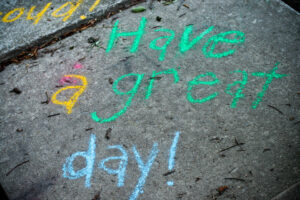 be approved by the teacher).
Then each team or class draws their kind, friendly messages on approved school-ground spots such as asphalt, sidewalks or playgrounds. It’s a colorful way to brighten your school grounds while kids practice kindness and collaboration.
And don’t overlook teens! I recently visited St. Francis High School in the Bay Area and noticed that their sidewalks were decorated with student-drawn inspirational kindness quotes.
3. Student Greeters
Clover Park School District in Washington recognized an untapped talent: students with strong social emotional skills who could serve as models to other students. And every school has friendly, kind kids whose skill set can be a powerful model for peers to copy. The staff identified these students and asked them to serve as student greeters. They wore red baseball caps so they were easily identified (other schools have made special vests). Greeters were stationed at the front door and welcomed entering students (“Hi!” “Glad you’re here!” “Have a good day.”) The staff reported a positive change in climate in just a short while. Students began to look forward to the greeting. And many arriving students began to return the same positive statements to the greeters.
4. Student Welcome Wagons
New kids can feel the pain of exclusion. So why not initiate a “Welcome Wagon Committee” of students to greet newcomers, give them a school tour, and pair them with “veteran” students. Photos of new arrivals can be featured on a faculty bulletin board to alert staff members of these students. Some schools with highly mobile populations arrange “get acquainted” sessions with new students where they learn about their school, connect with others, and practice kindness.
5. Cross-Age Buddies
This approach has been effective in boosting academic achievement and creating positive student connections. Student helpers are typically two to three grade levels ahead of the peers they tutor. Not only can they tutor students on academic tasks, but they can also teach the SEL skills to their younger buddy. And the experience can help build empathy, especially if the tutor assumes the role of a big brother or sister to a younger “buddy.” What’s more, the big buddy can begin to reframe his image and see himself as a caring person.
6. Learning Buddies
This idea was shared by a Vancouver teacher who assigned each student to be the learning buddy of another student in the classroom every week or month. Students pair up with their partners a few minutes a day. The strategy builds connections, enhances achievement and opens empathy. A few ideas:
- Students quickly turn to their buddies and agree on the task directions before they work on the task alone.
- Buddies discuss three main points from their homework assignment or from the task they just completed.
- The buddy calls or emails an absent partner to say: “We miss you,” provides missed assignments, or makes a get-well card with class signatures.
Or students (teachers, principals, bus drivers, cafeteria workers, yard supervisors, counselors, nurses, psychologists) can just take a moment to welcome and encourage one another. It’s also wonderful way to nurture students’ empathy and practice kindness.
There are countless ways for students to practice kindness and increase their empathy capacities. But look for real, meaningful, face-to-face type experiences. Those are the kinds of opportunities our students need to develop caring mindsets and become caring, socially responsible, good people.
**************************************************************************************************************************
 Teens today are 40 percent less empathetic than they were thirty years ago. Why is a lack of empathy—along with the self-absorption epidemic Dr. Michele Borba calls the Selfie Syndrome—so dangerous? First, it hurts kids’ academic performance and leads to bullying behaviors. Also, it correlates with more cheating and less resilience. And once children grow up, it hampers their ability to collaborate, innovate and problem-solve—all must-have skills for the global economy. The good news? Empathy is a trait that can be taught and nurtured. UnSelfie is a blueprint for parents and educators who want activate our children’s hearts and shift their focus from I, me, and mine… to we, us, and ours. It’s time to include “empathy” in our parenting and teaching! UnSelfie is AVAILABLE NOW at amazon.com.
See a Sensory Friendly Screening of Sing Tomorrow at AMC
Last updated on January 23rd, 2017 at 01:16 pm
 AMC Entertainment (AMC) and the Autism Society have teamed up to bring families affected by autism and other special needs “Sensory Friendly Films” every month – a wonderful opportunity to enjoy fun new films in a safe and accepting environment.
The movie auditoriums will have their lights turned up and the sound turned down. Families will be able to bring in snacks to match their child’s dietary needs (i.e. gluten-free, casein-free, etc.), there are no advertisements or previews before the movie and it’s totally acceptable to get up and dance, walk, shout, talk to each other…and even sing – in other words, AMC’s “Silence is Golden®” policy will not be enforced during movie screenings unless the safety of the audience is questioned.
 Does it make a difference? Absolutely! Imagine …no need to shhhhh your child. No angry stares from other movie goers. Many parents think twice before bringing a child to a movie theater. Add to that your child’s special needs and it can easily become cause for parental panic. But on this one day a month, for this one screening, everyone is there to relax and have a good time, everyone expects to be surrounded by kids – with and without special needs – and the movie theater policy becomes “Tolerance is Golden“.
Families affected by autism or other special needs can view a sensory friendly screening of Sing on Saturday, January 14th at 10am (local time). Tickets are $4 to $6 depending on the location. To find a theatre near you, here is a list of AMC theatres nationwide participating in this fabulous program (note: to access full list, please scroll to the bottom of the page).
Coming later in January: xXx: The Return of Xander Cage (Tues, 1/24) and Monster Trucks (Sat, 1/28)
****************************************************************************************************************************
Editor’s note: Although Sing has been chosen by the AMC and the Autism Society as this month’s Sensory Friendly Film, we do want parents to know that it is rated PG by the Motion Picture Association of America for some rude humor and mild peril. As always, please check the IMDB Parents Guide for a more detailed description of this film to determine if it is right for you and your child.

