
Summer Camp for a Kid with Food Allergies? Absolutely!
Last updated on May 25th, 2025 at 05:02 pm
 I know what you are thinking right now – me, send my allergic child away, to a camp? Are you out of your mind? How, where and what do you think I could do to stay sane while my child is away? I have some answers and (hopefully) you will find them helpful.
First, I would like to say that I understand the complexity of the entire scenario of sending your allergic child to a camp. I understand that it requires a lot of extra work and effort but what is it that is delaying the possibility- is it your fear of the unknown? If the answer is yes, that is ok and absolutely normal. With a few simple precautions, you could take the next step to having your child do what every other child without food allergies does.
The easiest way to start is something that Dr. Michael Pistiner of AllergyHome shared at the US Anaphylaxis Summit in Washington D.C.: “A.C.T. – Avoid, Communicate, Teach”. Be able to explain which foods must be avoided to ensure a safe environment for your child at camp as well as the others who may have food allergies. Communicate openly with the camp staff on all levels so that they feel comfortable working with you as much as possible. Teach them because many times, people are embarrassed to tell you that they are unsure of how food allergies should be handled. The more you make yourself approachable and willing to share your information, the easier it will be to begin to open up those doors for your child to enjoy that summertime rite of passage.
Searching for a camp that will be able to accommodate your child’s needs may be a bit tricky but I’m happy to say that there are more and more allergy-friendly camps that are becoming available to parents. These camps also include dairy free, asthma and children who have skin conditions that are excited to spend summertime with others in a fun environment. Not sure where to start the search? Here’s a sample of just a few of these camps right here:
Allergy-Friendly Summer Camps
Asthma Camps
Dairy Free
Skin Conditions
Now, one of the most important parts of what you need to remember may seem just a teeny bit selfish at first but just let the thought sink in for a bit. This will also be your time to relearn how to be your own person outside of being a food allergic parent. Let’s face it, when was the last time you did something that was for yourself? You – not the nut allergic child’s mom, not the protective parent and not the unconditional caretaker but you as your own person. I am not saying you have to go wild but I am reminding you that finding yourself and allowing you to find yourself is a very healthy and necessary thing to do. Even if you allow yourself ten minutes a day, you will find that it helps you to de-stress just a bit, can refocus you and it can even give you just enough space for you to sit back and watch your child impress you on how educated they are about their food allergies because of you.
We all choose how we want to handle our situations. The unknown can be extremely scary but small steps can lead to bigger steps, bigger steps to leaps and bounds. Be cautious (be VERY cautious) but also be willing to show your child that new things can be achieved. Show them that they are important enough for you to try. Show them that life is not built around fear but of the strength of what they can achieve, bumps in the road and all. Show them that food allergies are a part of them, not the end of them.
March 5th at AMC, The Unbreakable Boy is Sensory Friendly
Last updated on April 14th, 2025 at 06:35 pm
 Since 2007, AMC Entertainment (AMC) and the Autism Society have teamed up to bring families affected by autism and other special needs “Sensory Friendly Films” every month – a wonderful opportunity to enjoy fun new films in a safe and accepting environment. And this coming Wednesday, The Unbreakable Boy is Sensory Friendly at AMC.
The movie auditoriums will have their lights turned up and the sound turned down. Families will be able to bring in snacks to match their child’s dietary needs (i.e. gluten-free, casein-free, etc.), there are no advertisements or previews before the movie and it’s totally acceptable to get up and dance, walk, shout, talk…and even sing – in other words, AMC’s “Silence is Golden®” policy will not be enforced during movie screenings unless the safety of the audience is questioned.
Does it make a difference? Absolutely! Imagine …no need to shhhhh your child. No angry stares from other movie goers. Many parents think twice before bringing a child to a movie theater. Add to that your child’s special needs and it can easily become cause for parental panic. 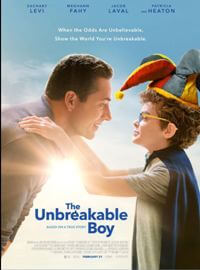 But on this one day, for this one screening, everyone is there to relax and have a good time, everyone expects to be surrounded by kids – with and without special needs – and the movie theater policy becomes “Tolerance is Golden“.
Families affected by autism or other special needs can view a sensory friendly screening of The Unbreakable Boy, this Wednesday, March 5th (check your local theater for times). Tickets are typically 25% off for the sensory friendly screenings, depending on the location. To find a theatre near you, here is a list of AMC theatres nationwide participating in this fabulous program (note: to access full list, please scroll to the bottom of the page).
Also Sensory Friendly at AMC in March: Captain America: Brave New World (Sat. 3/8 and Wed. 3/12)
****************************************************************************************************************************
Editor’s note: Although The Unbreakable Boy has been chosen by the AMC and the Autism Society as this month’s Sensory Friendly Film, we do want parents to know that it is rated PG by the Motion Picture Association of America for strong thematic material, alcohol abuse, language and some violence. As always, please check the IMDB Parents Guide for a more detailed description of this film to determine if it is right for you and your family.
6 Things New Parents Need to Know About Car Safety
Last updated on January 17th, 2026 at 07:02 pm
As a new parent, baby safety is your top priority – and keeping your newborn safe in the car is most likely on your mind. Here’s what you need to know about safety on the road.
 1. Be car-seat safe. You know that an infant car seat will help protect your child in the event of a crash. But make sure the seat has a sturdy harness system, is placed rear-facing, and has padding around the sides to support your baby. Also check that your car seat is installed safely. If you’re unsure, find a certified car seat inspector near you at SeatCheck.org.
2. Buckle up, always. Speaking of car seats, your baby should always be in one when you’re in a vehicle. It might be more fun to hold her and buckle up together, but an infant (or a child) should never ride in your arms.
3. Babies in the back. You might be tempted to put your baby’s car seat up front so you can keep a closer eye on him while you’re driving, but don’t. The backseat is the safest and best for babies and children, who could easily get hurt by a deployed air bag if you were to get into an accident.
4. Watch the windows. To keep your baby’s fingers from ever getting pinched, always look before closing automatic windows. Keep them closed by turning on the child window locks.
5. Never talk or text while driving. A whopping 78 percent of moms admit to talking on their phones while driving (and 26 percent say they text or check email). You’ve heard it a million times, but here it is again: Never use your phone to talk or text while you drive – it’s just not worth the risk.
6. Always bring your baby with you. Don’t leave your baby alone in the car while you pop into stores to run errands, or for any reason at all. Children’s bodies heat up faster than adults’, and the temperature inside your car can jump 20°F in just 10 minutes! That puts your baby at serious risk for overheating, and even having heatstroke, or worse.
Keeping Your Family Safe from Frostbite
Last updated on March 29th, 2025 at 04:03 pm
 This year we had an extended break over the holidays in order to visit the Canadian grandparents and ski the Canadian Rockies in Alberta. It’s a very beautiful part of the world and I do love visiting there….but in the winter, it is COLD! Which is why I couldn’t help but laugh while we were packing for the trip – in our Midwest American winter – when my husband asked if I was packing the sunscreen. Seriously?! Whatever for? You see, however much sunlight might reflect off snow while skiing, creating a risk for sunburn – in the Canadian Rockies – EVERYTHING needs to be covered up, even your face.
Our 12-year old son learned this the hard way, when he began getting frostbite on his cheeks after extensive time out on the slopes on one of the colder days. We took care of it in fairly short order, but when I returned back to the U.S. and discovered it was actually COLDER in the Midwest than it had been in Canada, the idea of a frostbite post seemed like a good idea.
Windchill and Frostbite
When considering frostbite risk, a good place to start is with windchill, which is the term used for the rate of heat loss from the human body resulting from the combined effect of low temperature and wind. As winds increase, heat is carried away from the body at a faster rate, driving down both the skin temperature and, eventually, the internal body temperature.
It’s important to note that the only effect that windchill has on objects (or people) is that it shortens the time that it takes the object to cool to the actual air temperature (it cannot cool the object down below that temperature). Windchill matters because, for any given temperature, with increasing winds, it increases the risk of – and reduces the time for – frostbite of exposed skin to occur.
A Frostbite Primer

A case of frostnip
At or below freezing (32 °F or 0 °C), blood vessels close to the skin start to constrict, and blood is shunted away from the extremities, like fingers, toes, ears and nose. The same response may also be a result of exposure to high winds. This constriction is helpful as it preserves core body temperature. However, in extreme cold – or when the body is exposed to cold for long periods – this protective strategy can reduce blood flow in some areas of the body to dangerously low levels. This lack of blood leads to the eventual freezing and death of skin tissue in the affected areas.
The level of severity of frostbite is characterized in degrees – similar to burns – with the least severe level known as first degree, or the quaint, “frostnip”. Below is an outline of the degrees of frostbite severity:
First degree (aka Frostnip)
- Superficial cooling of the surface of the skin, without destruction of the skin cells.
- At onset, there is itching and pain, then the skin develops white, red, and yellow patches and becomes numb.
- Affected area usually does not become permanently damaged as only the skin’s top layers are affected – though long-term insensitivity to both heat and cold can sometimes happen after suffering from frostnip.
Second degree
- If freezing continues, the skin may freeze and harden (destroying skin cells), but the deep tissues are not affected and remain soft and normal.
- Injury usually blisters 1–2 days after becoming frozen. The blisters may become hard and blackened, but usually appear worse than they are.
- Most of the injuries heal in one month, but the area may become permanently insensitive to both heat and cold.
Third and fourth degrees
- If the area freezes further, deep frostbite occurs. The muscles, tendons, blood vessels, and nerves all freeze and can be destroyed.
- The skin is hard, feels waxy, and use of the area is lost temporarily, and in severe cases, permanently. The deep frostbite results in areas of purplish blisters which turn black and which are generally blood-filled. Nerve damage in the area can result in a loss of feeling.
- May result in fingers and toes being amputated if the area becomes infected with gangrene. If the frostbite goes untreated, they may fall off.
Frostbite Prevention
In order to avoid frostbite in the first place, it’s helpful to keep track of both the actual temperature – and the windchill or apparent temperature – and plan your time outdoors accordingly. For example, at an actual temperature of -10 °F, a light wind of 5 mph will make it feel like -22 °F and could cause frostbite after 30 minutes of exposure. But if the wind increases to 25 mph, it will feel like -37 °F and frostbite could occur in just 10 minutes – which might explain all the recent school delays and closures! The National Weather Service has a helpful windchill chart with estimated times for frostbite to occur.
When you and your family are outdoors in cold weather it’s also important to consider the following:
- Dress in layers of loose, warm clothing – and check for gaps in the coverings (such as between gloves and sleeves)
- Wear a hat or covering on your head – and make sure your ears are covered
- Wear mittens rather than gloves – so your fingers can share warmth
- Wear socks and sock liners that fit well, wick moisture and provide insulation
- Consider using hand or foot warmers – we got a lot of benefit from these skiing in Canada
- Try to keep moving outside to get blood flowing
Most of all, be aware of and check for signs of frostnip and frostbite, such as red or pale skin, and prickling feelings or numbness in the skin.
Frostbite Treatment
Frostnip – or mild frostbite – can be treated at home. It’s important to get out of the cold soon after the signs appear and change into dry clothing if needed. Warm the area gradually using warm (not hot!) water – about 100 to 150 degrees Fahrenheit (no hotter!) – or body heat such as a warm hand pressed on the cold skin. A couple of watch-outs:
- Do NOT rub or massage the area – this can further damage the skin
- Do NOT use direct heat from a heating pad, lamp, fire or radiator – as your skin will be numb and you will not be able to detect when it is burning
More serious frostbite needs medical attention immediately. Again, warm the area gradually, but do not start warming if the area may become exposed to cold again – this can make the situation worse. Remove any tight or wet clothing, and rest affected areas (e.g. do not walk on frostbitten feet). Also, leave any injured tissue intact for a physician to address – and follow the restrictions above for frostnip.
Thanks to my husband for the inspiration and much of the research for this post!
The Other Gifts We Give Our Kids
Last updated on January 6th, 2025 at 02:28 pm
 There are many traditions at this time of year that involve parents giving their children presents – whether obviously or through Santa subterfuge! But there are many gifts we give our kids throughout the year that have a much more lasting impact than the latest hot video game or toy, even if our little people don’t yet realize it or always appreciate our efforts. Below is a selection of some of these gifts of love.
Vaccinations
The WHO cites a detailed history of vaccination that demonstrates how only clean water has done more for the health and wellness of mankind. Historical books, movies and TV shows detail just how frightening the diseases we vaccinate against once were. The shots we get for our children are a gift that provides a lifetime of protection – for them and those around us.
Safe Home
Every time parents install a cabinet lock to hide chemical cleaners, secure heavy furniture and TVs against tipping, or reduce the setting of their water heater they are providing invaluable gifts to their children – reduction in the risk of preventable poisoning, injury, burns. The Consumer Product Safety Commission says that almost 1,800 kids are seen in Emergency Departments each year due to injuries from furniture and TV tip-overs – and 119 kids between 1 and 3 years old die annually from these incidents.
Safe Transport
Around 400-500 child deaths are prevented in the US every year due to use of car seats and other child restraints – and that’s not counting the reduction in severe injuries from use of safety seats for kids. Every time we strap them into a car seat we are giving them a precious gift and teaching them good car safety habits for when they become drivers.
Healthy Eating Appreciation
Obesity is one of the greatest health crises of our age, given its link to diabetes, heart disease, high blood pressure and cholesterol, liver disease, sleep apnea, arthritis, and even several cancers. Helping our children appreciate food for its support of health is a gift that keeps giving over a lifetime.
Active Lifestyle Encouragement
As parents, we all want our children to live a long and happy life. Physical activity is a important contributor to this goal, given how it reduces risk for chronic diseases and even improves mental health, sleep and mood.
According to the US Centers for Disease Control, “only a few lifestyle choices have as large an impact on your health as physical activity. People who are physically active for about 7 hours a week have a 40 percent lower risk of dying early than those who are active for less than 30 minutes a week.”
Getting our kids to be active – and, more importantly, being a role model for physical activity is literally a gift of life.
Protection from Excessive/Inappropriate Online Exposure
Although the American Academy of Pediatrics has updated their guidelines for “screen time” to better reflect how entrenched online usage now is at all ages, they still make recommendations – such as developing personalized media use plans for your kids that takes into account each child’s age, health, personality and developmental stage – to ensure a valuable online experience. Putting limits in place for when our kids can access the internet and what they can see is an important gift for protecting their online reputation and preventing inappropriate connections.
So while you are savoring your kids squeals of delight when they open their presents during the holidays, remember to pat yourself on the back for all the other gifts you labor to give them year-round – gifts that protect them for a lifetime.
Saving Lives – Helping Kids Escape a Locked Car Trunk
Last updated on March 29th, 2025 at 04:04 pm
 We all know little kids love to climb. And hide-and-seek is often a favorite game. Unfortunately no matter how often you stress the danger, a car trunk can still look like a great place to play. That said, I think all of us would agree that with little kids around it’s a good idea to have an internal trunk release – especially since they are known to be the easiest and fastest way to escape from inside of a car trunk. What may not be commonly known however is that most vehicles older than model year 2002 do NOT have a trunk release accessible from inside the trunk compartment. An organization called Kids and Cars has made it a priority to not only pass on this information but to try and address the problem.
Kids and Cars‘ goals are to ensure that not only are children never left unattended in or around vehicles but also to support the design of safer vehicles that eliminate unnecessary deaths and injury to children. Kids and Cars maintains a national database tracking deaths and injuries to children left unattended in or around motor vehicles. Currently there is no federal or state agency that collects this information
In 2009, Janette Fennell, founder of Kids and Cars.org appeared on SpikeTV’s “Surviving Disaster: Home Invasion” during the segment on how to escape from a locked car trunk. Shortly after the broadcast, (upon receiving an abundance of requests), Kids and Cars began offering an after-market Emergency Trunk Release kit. If you do not currently have an emergency glow-in-the-dark trunk release, it is imperative you purchase one, whether from Kids and Cars or elsewhere; if you have one I highly recommend making sure every child knows what it is and how to use it.
Too many children have lost their lives after gaining access to a car trunk that did not have this simple safety device. Not a single trunk related fatality has been reported where one of these devices was installed.
The message is clear…we just need to hear it.

