
How Your Dog Is Affected By Your Family’s Emotions
Last updated on December 9th, 2024 at 12:45 am
As humans, we all experience a very wide range of emotions for any given situation, at any given time. And oftentimes, we tend to ‘assign’ those same emotions onto the animal that spends the most time at our sides – our dogs.
 The following is just a short list of some of the statements I consistently hear from my clients about their dogs:
- “She knows exactly what she did wrong! The minute I came into the room, she ran!”
- “He ate the arm of the couch because he was angry (or mad) that I went out without him!”
- “He destroyed my son’s favorite pair of slippers to get even with him for yelling at him!”
In general, I spend a great deal of time dispelling some of the myths regarding a dog’s ‘emotions’ and more importantly, their ‘actions’ – which are more reactions than actions.
What do I mean by this? Let’s review the above statements and break them down. In each one, the person is assuming that the dog’s actions are based on an emotion. The reality is that to feel guilty, or to retaliate out of anger requires a cognitive thought process… one of “I’ll show you!” Sorry folks… dogs do not possess the ability to dissect everything the way we do. They live in the moment and rely heavily on instinct. They clearly read your body language, their instinct of self-preservation kicked in and they decided to get out of the line of fire! They had no clue why you were displeased…. they just knew by your body language that you were!
On the flip side of that, there are basic emotions that dogs can/do feel… for example, they can feel anticipation of something good or bad to come. If your child comes home from school every day at the same time on the bus, you will see them excitedly pace in front of the window or door as that time rolls around, and display excitement at every bus that passes until they see one stop and your child disembark. They can also feel happy when your child runs in, drops down on all fours and lavishes love on them. And because they can physically feel barometric changes, if thunderstorms frighten them, they may exhibit stress-related behaviors in anticipation of the impending storm. Other human emotions that dogs can feel and display are fear, feeling threatened, anxiety, sadness, and pleasure. I do not know for sure if they actually feel love, but by their obvious displays of affection, I like to think they do.
So why did I explain all of that and what does it have to do with my topic? Because how we feel, behave, and act can have a profound effect on our dogs, and can cause them to act or react in a positive or negative way. I had touched on this a bit in my article on teaching special-needs kids how to use “calm energy”. In one of the examples, I discussed the differences I saw in the way the dog reacted to the hyperactive child versus how they reacted to older or calmer family members, and then related my own personal struggles in my early training career of working with small toy breeds.
Even a calm, even-tempered, well-mannered and well-trained dog can react negatively in situations that they had once previously enjoyed but have since started to feel hostile.
 My dog Reilley had enjoyed going everywhere in the car with me since he was a baby. All I had to do was grab my keys and he was running to his ‘Service Dog in Training’ vest so he could join me. About a year ago, from what seemed to be ‘out of nowhere’ he was hiding when I got my keys and didn’t want to go! I had to use firm commands to get him to come out, and when we got into the car, he would start whining, crying, and shaking. For the life of me I couldn’t figure out why! Then one day the reason suddenly became very clear.
We had just finished at my doctor’s, he was calmly and quietly lying in the back seat, and someone cut me off. We were not in an accident- not even close- but the barrage of angry insults that came streaming out of my mouth had him crying and shaking all over again! And suddenly, I got it. In general, I tend to be a pretty up-beat easy-going person, but there had been quite a bit of emotional upheaval in my life at that time, and because I dislike driving to begin with, that became my time to ‘let it out!’ My husband had spoken to me numerous times about this and I knew my behaviors upset him, it just never occurred to me how much my actions and behaviors were affecting my dog!
How can this relate to your household? Dogs rely completely on routine, schedules, rules and consistency… and in an ideal world, we could always stick to that! Unfortunately none of us live in an ideal world…. and things change. But in a dog’s world, just one of those four things changing on them can totally throw them out of balance. We all get angry, upset, frustrated, over-exuberant… and so do our kids! Even more so it seems, now that we’ve added in the emotional overload that appears to be accompanying the current U.S. elections. But scroll back up to that limited list of emotions that dogs feel… anything outside of those can be very confusing to them. Also, just because they may feel those feelings, it doesn’t mean they can understand them! A dog calmly sleeping when an argument erupts, or a door gets slammed, or shouting begins, can become frightened, causing them to resort to one of two behaviors that come instinctively to them; Fight or flight. Some dogs when panicked will take off and hide, others will steel themselves to do battle.
Remember also that sometimes it is not just family arguments or a child’s sudden temper tantrum that can set them off… An innocent game of tag between your child and their friends is confusing to your dog. They don’t understand the friend is ‘tagging’ your child – or even that it is a game! They see someone hitting a member of their pack, and they may suddenly go into ‘protection’ mode. Your teenager daughter’s high-pitched squeal while on the phone with her girlfriend may have startled and then annoyed you, but if Rover was relaxing on your son’s lap chilling, you may need a few band-aids as you remove his nails from your son’s leg!
So how do we keep everybody in the household (including the dog) safe? Well, the best place to start is by observing your dog during some of these times, and how they react. Start a journal marking down the date, the time, the action, the child’s reaction, and then the dog’s reaction.
Example:
- 9/5/24 – 5:00 pm: Told John to turn off the computer and do homework 3X. He ignored me. I got angry and stormed upstairs while yelling. Argument ensued. Dog peed on the rug during that time-frame.
- 9/6/24 – 7 :00 am: Woke Jane up for school three times. She missed the bus, expected a ride and I refused. Argument ensued. Dog started whining and panting and then hid the rest of the morning.
- 9/11/24 – 6:00 pm: car backfired, dog started growling before he ran under the bed.
- 9/12/24 – 4:15 pm – Michael came home from school, front door closed quickly behind him with a loud bang, dog barked at him then ran under the bed.
- 9/13/24 – consistently noticing since the bedroom door was slammed, all loud noises scare him.
Essentially what this is creating is a document of how the family’s behaviors (yours included) are directly affecting the dog’s behaviors. Now, it is time to call a family conference. Begin by stating to your child or children that you are noticing some troubling behaviors in the dog lately, and to understand why these behaviors were happening and to best figure out how to help him, you began documenting what was going on prior to the behavior. Before reading any of the entries out loud, make it clear to everyone that this is not about pointing fingers or laying blame, but rather a group effort to figure out what you all, as a family, can do and change to help Fido.
Assuming the dog and the kids have a good solid relationship, it stands to reason they will all be interested in banding together to help him. You can also ask if there were any behaviors they might have noticed that you missed. If finger-pointing and blame begins, remind them gently that it is not about getting each other in trouble… its about your concern for the dog, who has always been nothing but kind and loyal to everyone, and helping him to overcome his new negative behaviors.
You can also potentially start an alternative list…. A ‘positive reactions’ list, that chronicles tender, loving or kind moments that you happen to notice. This way, if any of the kids are choosing to not be involved, you can gently remind them, “Michael, last week when you were really upset about not making the team, Fido sat next to you and didn’t move for hours because he knew you were upset and needed a friend. Are you willing to be his friend now when he really needs you?”
Once everyone is on board and willing to help, go back over the list one by one, and say something like, “Okay… John… how could you and I have communicated better about the computer, so we didn’t both get so angry?” etc.
Allowing the kids to have an active role helps to create unity… everyone coming together to create a calmer, happier environment ‘for the dog.’ All the while learning to be a bit kinder to each other. Talking without screaming and listening to each other. Acknowledging that they heard what the other one has to say. What they may not realize, however, is that they are learning to work together…and coming together as a family. Which in the end, is helping everyone! What a beautiful gift!!
The WarmMe: The Safe Car Seat Winter Coat Alternative
Last updated on July 6th, 2025 at 03:26 pm
 In the Winter of 2012, I found myself as a first time mom of a beautiful 6 month old baby girl and I had a problem. We had moved my daughter out of her infant car seat and into a convertible car seat, she was just too heavy to carry around in the infant seat. The problem was it was winter and I didn’t know how to keep her warm while also keeping her safe in her new seat. I had read many articles and seen many graphics online about the dangers of using a winter coat under the straps of car seat harness.
A winter coat is too bulky to safely and securely use under a car seat harness. We did the quick test suggested in multiple articles, put the child in their coat and secure the harness straps, tightening them until they feel snug, then take the child out of the seat and remove their coat, put them back in and buckle the straps. We were shocked by the results, we were certain the straps had been tight when the coat was one, but once the coat was removed there was so much slack in the straps! In the case of a car accident, the force from the accident would cause the child’s winter coat to compress against the straps and the result would be gaping, loose straps that a child could slip through. More recently (January 8, 2024), Consumer Report issued a report and video on this exact danger. They suggest removing the child’s coat and putting it over them like a blanket once they are secured in the car seat, or using a blanket to cover the child.
 So, how would we keep our little girl warm throughout a cold Michigan winter? We tried multiple options including putting her coat or snowsuit on in the house and removing in the car then putting it over her once she was buckled. We tried layering blankets over her once she was buckled. We tried lightweight sweatshirts under the straps. None of these options were convenient or warm, taking the coat on and off was probably the most time consuming, the blankets didn’t stay on, and the sweatshirts just weren’t warm enough. That’s when I knew there had to be a warm and safe alternative to the winter coat. I decided to make something as warm as a blanket that would stay on without the need for removing in the car. I thought that something like a poncho would work the best, and so the first version of the The WarmMe was born.
The first version of The WarmMe was very basic, it kept my daughter warm and safe in the car, so it served it’s purpose but I felt there were improvements that could be made. The WarmMe had a single button on the front to secure it and made opening the front simple and easy for securing the car seat harness underneath. The first WarmMe was made of a fleece lined sherpa material that was cute and cuddly, but pricey plus very limited on color selection. The WarmMe worked well that first winter, so the next winter I made an identical one that was just a bit larger to fit my quickly growing daughter.
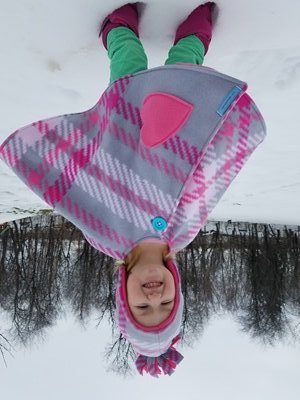 This second winter my daughter was becoming more independent and always wanting to walk rather than be carried, even on cold and windy winter days. I noticed that on a windy day her WarmMe would blow open when she was walking around outside. I decided to add something special that sets The WarmMe apart from other ponchos and kept my little girl warm even on windy days-by a special feature, interior pockets. The pockets on the inside allowed my daughter to keep her hands warm and also wrap The WarmMe around herself when she was wearing it outside of the car. Her second winter, my daughter loved her new and improved WarmMe with the added pockets. This was also when I decided to change the material from the sherpa to fleece. Fleece is much easier to work with especially when adding the pockets, has endless color and print combinations available, and is easily washable (a definite bonus when creating something for little kids!).
People stopped us all the time asking where were got The WarmMe and when I said I made it they started encouraging me to sell them. At this point in time I had two young children and was working part time as a school social worker, adding to a small business to my already full and busy life didn’t seem to make sense to me. Plus, my whole goal was to keep my daughters safe in the car, how could I put a price on that?
 In October 2015 my life changed. I suffered a traumatic miscarriage. As our dream of adding a 3rd baby to our family was crushed and I was left in the most physical and emotional pain I have ever experienced, I found myself needing something I was passionate about to get me out of the dark place I was stuck in. At this point I had made a couple WarmMes as gifts for friends and family and the feedback was great, they loved how much easier it made everyday life. That’s when I went for it, I decided to take a chance and put them up for sale, as I realized I could reach a lot of parents and caregivers who were looking for a safe way to keep their little ones warm. The business started very small, just a couple postings on my personal Facebook page that were then shared by my family and friends.
Each WarmMe has always been custom made based on the child’s clothing size and the print or color preference, so I just focused on completing each order as it came in. People soon started asking for added features such as an attached hood. After asking around and doing a little experimenting I decided a hood is just too bulky to be comfortable behind a child’s head and neck while riding in the car. I decided to start offering matching hats and they’ve been a hit! The next request was for matching scarves for the mom or dad and that option was quickly added in what I like to call the “Mommy and Me Set.”
In February 2016, The WarmMe was featured on a segment called “Moms a Genius” on WXYZ Detroit and the business picked up from there. I could no longer keep up with orders on my own, so my wonderful and supportive husband stepped in to help. In 2017, The WarmMe made the news again on my local news station WLNS 6 out of Lansing, MI and has been picked up by other stations in states such as South Carolina, North Carolina, W isconsin, Indiana, Minnesota, Ohio, New York, and Virginia. This holiday season The WarmMe has been sent to cold states all over the map. The best part of the increased business has been the feedback from happy customers. Almost daily I receive messages stating how much parents and children alike love The WarmMe and how it has made life easier by keeping little ones safe and warm! It is amazing knowing that my product is making life a little easier for parents, while keeping their precious little ones safe! I’m very happy to say that both The WarmMe business and our family are growing as we are expecting the newest addition to our family in January 2017!
HEALTHFUL HINTS:
- While the WarmMe is designed to young children safe and warm in their car seats, there are also products designed to fit safely over infant seats while not interfering with the ability to securely buckle the harness. These products are ones that do not go between the child and the car seat or buckles, but go over the seat similar to a shower cap.
- If taking a long road trip or traveling far from home when road or weather conditions are really bad (remember, I’m talking Michigan winters!) take along coats, snowpants, or snowsuits. If something were to happen and you ended up stranded these items would definitely help keep your little one warm until help arrived.
- Remember safe sleep precautions when using The WarmMe, similar products, or blankets to keep your child warm in the car seat. Always be sure the fabric is away from their face allowing for an open airway. If transferring a sleeping child from the car into their bed always remove The WarmMe.
- Here is the official Consumer Reports recommended “simple way to check if your child’s coat is too big and bulky to wear under their harness”
- Put the coat on your child, sit them in the child seat and fasten the harness. Tighten the harness until you can no longer pinch any of the harness webbing with your thumb and forefinger.
- Without loosening the harness, remove your child from the child seat.
- Take the coat off, and put your child back in the child seat and buckle the harness straps, which are still adjusted as they were when he was wearing the coat.
- If you can now pinch the webbing between your thumb and forefinger, then the coat is too bulky to be worn under the harness.
THE WILD ROBOT is Sensory Friendly 2x in October at AMC
Last updated on November 17th, 2024 at 03:22 pm
 Since 2007, AMC Entertainment (AMC) and the Autism Society have teamed up to bring families affected by autism and other special needs “Sensory Friendly Films” every month – a wonderful opportunity to enjoy fun new films in a safe and accepting environment. And this coming Saturday, The Wild Robot is Sensory Friendly at AMC.
The movie auditoriums will have their lights turned up and the sound turned down. Families will be able to bring in snacks to match their child’s dietary needs (i.e. gluten-free, casein-free, etc.), there are no advertisements or previews before the movie and it’s totally acceptable to get up and dance, walk, shout, talk…and even sing – in other words, AMC’s “Silence is Golden®” policy will not be enforced during movie screenings unless the safety of the audience is questioned.
Does it make a difference? Absolutely! Imagine …no need to shhhhh your child. No angry stares from other movie goers. Many parents think twice before bringing a child to a movie theater. Add to that your child’s special needs and it can easily become cause for parental panic.  But on this one day, twice a month, for this one screening, everyone is there to relax and have a good time, everyone expects to be surrounded by kids – with and without special needs – and the movie theater policy becomes “Tolerance is Golden“.
Families affected by autism or other special needs can view a sensory friendly screening of The Wild Robot on Saturday, October 12th or Saturday October 26th (check your local theater for times). Tickets are typically 25% off for the sensory friendly screenings, depending on the location. To find a theatre near you, here is a list of AMC theatres nationwide participating in this fabulous program (note: to access full list, please scroll to the bottom of the page).
Also Sensory Friendly at AMC in October: Joker: Folie a Deux (Tues. 10/9)
****************************************************************************************************************************
Editor’s note: Although The Wild Robot has been chosen by the AMC and the Autism Society as this month’s Sensory Friendly Film, we do want parents to know that it is rated PG by the Motion Picture Association of America for action/peril and thematic elements. As always, please check the IMDB Parents Guide for a more detailed description of this film to determine if it is right for you and your family.
Online Meets Offline Lesson: Don’t Let Kids Learn the Hard Way
Last updated on October 23rd, 2024 at 05:50 pm
When something about us ends up online and affects us in a negative way, I call it the Online Meets Offline lesson. It’s a lesson that we all need to learn as soon and as painlessly as possible. The problem can originate from something that happened online, such as a post someone made or when something offline, such as a news story, gets posted online. The video below shows some great examples of teenagers and young adults learning the Online Meets Offline Lesson the hard way.
Either way, once it’s online, it’s there for the world to see and it probably isn’t going away anytime soon. This is a lesson that kids often have a difficult time understanding, as McAfee software, one of the leading companies that works to protect people from learning the lesson the hard way explains.
When it does happen, they tend to fall into several “types” of incidents:
Pushback from the Public
In a case here in my home state of Pennsylvania, a teacher made derogatory comments about her students in her blog back in 2009. Even though she did it anonymously, her identity was discovered. She was fired as a result and sued to get her job back, claiming Freedom of Speech, going as far as the U.S. Supreme Court. In the end, she lost her case. In more recent examples, people have lost their jobs after making comments after the attempted assassination attempt on former President Trump.
Providing Evidence of a Crime
There’s a saying that if they were smart, criminals wouldn’t be criminals in the first place. I agree and that point is never so evident as when people post (often live) about something that they’re doing, and their own post ends up being used against them in court. Here are a few examples of that happening. My favorite is the story from Utah of the man who showed himself stealing gas from a police vehicle.
Checking-In Can Cause Unexpected Problems
 Even when people do what would appear to be something innocent, it can cause major problems. We all like to “check-in” on social media, especially kids. Or post pictures of ourselves having a fun time. It helps them show to others that they’re fun and maybe popular (if they’re with others).
The problem here is that it tells people exactly where you are and where you aren’t. Anyone looking for you, such as a disgruntled classmate, an ex-partner or even a criminal, knows where they can find you or at the opposite end, knows that you’re not at home, making your home a target for a robbery or other criminal actions.
These kinds of posts become part of our Digital Footprint, something that kids applying for jobs or to schools need to keep in mind. And just because something gets deleted later may not be enough – it’s better to T.H.I.N.K. (see below) about what we post before doing it to avoid problems later. An ounce of prevention is worth an immeasurable amount of cure.
Takeaway
For better or worse, we live in a world where just about everything about us has the potential to go online and go viral, even if it didn’t start there. That can help us in many ways, but it can hurt us in many ways as well. To help prevent that from happening, take the following actions:
- Keep your privacy settings to their most restrictive to keep strangers from seeing your posts.
- Avoid checking-in live – do it later and say that you HAD a great time, not that you’re HAVING a great time.
- Use common sense about what you post. When in doubt, use the T.H.I.N.K. Principle, as recommended by Fifty Shades of Purple Against Bullying. Each letter represents a specific criterion (True, Helpful, Inspiring, Necessary and Kind) that people should consider before they post something to see if they should hold off instead.
The Online Meets Offline Lesson is one I’ve seen people of all ages learn the hard way and the repercussions can be as mild as some gentle teasing by classmates to something as bad as losing a job or getting physically assaulted (or worse). Learning the lesson at a younger age makes it easier for it to become second nature, protecting your children for many years to come, so make sure that your children and everyone in your family takes the three steps above to help them avoid learning the lesson the hard way.
If you want to see some more examples of how a person’s Digital Footprint can affect the in the “real” word, just search for the following hashtags: #OnlineMeetsOffline, #PublicAndPermanent, or #DigitalFootprint. Some of the stories will make you laugh, and others will make you cringe, so the sooner people learn this lesson, the better they will be.
Erin’s Law: Teaching Kids to Recognize & Avoid Sexual Abuse
Last updated on September 7th, 2024 at 06:30 pm
In October 2011, New York State announced it would join the ranks of those states that have introduced a bill  entitled Erin Merryn’s Law. The measure would require schools to make a change to their existing curriculum for child abduction to include child sexual abuse prevention. This alteration would give critically important information to victims – many of whom do not know there is a way out of their horrific situation. As a child, Merryn was abused by both a neighbor and a family member. She says she stayed silent due to a combination of threats from her abusers, and the lack of knowledge about available help. When it passed, New York became the 37th state to enact Erin Merryn’s law, following Missouri and Merryn’s home state of Illinois.
It would take until 2015 for a federal version of Erin’s Law to be signed by President Obama under the Every Student Succeeds Act. Still, as each day passes…as another child assault is reported in the news or another adult tells the story of their stolen childhood…we are reminded that parents should continue to be vigilant about teaching child sexual abuse prevention in the home. By age three, children should be taught that their bodies have private parts and no one is to touch those parts (with the necessary medical and hygiene exceptions). Of course children should be taught the correct terminology for their body as nicknames can be confusing and delay a disclosure.
The following are some tips that are often overlooked:
- When someone tickles a child, if the child says No, all tickling should cease. Children need to know that their words have power and No means No.
- Teach children that it is OK to say No to an adult. Without permission from you, many children may be reluctant to do so even if the adult is doing something that makes them feel uncomfortable.
- Teach children that all of these lessons apply to other children as well. If another child is touching your child in a way that makes him or her uncomfortable, teach your child to say No, get away and tell someone.
- Be careful with the language you use when speaking with children. Avoid saying things such as “Have a good day and do everything your teacher tells you to do.” Children are very literal and need to be told that they should not listen to someone who is telling them to do something that might be harmful to them or to someone else.
- Let your child decide how they want to express affection. If they do not want to hug or kiss Grandpa goodbye or sit on Santa’s lap, do not force them. You take away their power over their own body if you force them to be demonstrative in their affection. Children need to be taught their body belongs to them.
- Teach children to respect the privacy of others. They should learn to knock on doors that are shut before opening them and close the door to the bathroom when they are using it. If they learn to respect the privacy of others, they may be more likely to recognize that an invasion of their privacy could be a red flag meaning danger.
- Use your poker face. Encourage your child to come you if they have questions about anything. Avoid looking shocked or embarrassed by the question. Children who sense their parents’ discomfort will be less inclined to approach the parent next time he or she has a question.
The U.S. Centers for Disease Control and Prevention estimate that 1 in 4 girls and 1 in 20 boys is sexually abused by age 18 in the United States. 90% of the abuse happens at the hands of those trusted by the child or the child’s family members. With the passage of Erin Merryn’s Law, critical information now has the ability to reach every child in the United States…and we are beginning to see Erin’s Law recognized internationally.
Are you teaching child sexual abuse prevention in your home?
Childhood Sports Injuries: Avoid Both Common & Serious Problems
Last updated on September 7th, 2024 at 06:27 pm
The school year will soon be upon us and with the return of homework and uniforms means the  return of sports. 60 million children and adolescents participate in organized sports in the United States each year. Still more participate in informal recreational activities. Although sports participation provides numerous physical and social benefits, it also has a downside: the risk of sports-related injuries. In fact, according to Nationwide Children’s Hospital, approximately 3 million youth are seen in hospital emergency rooms for sports-related injuries and another 5 million are seen by their primary care physician or a sports medicine clinic for injuries.
These injuries are by far the most common cause of musculoskeletal injuries in children treated in emergency departments. They are also the single most common cause of injury-related primary care office visits.
I. The Most Common Sports-Related Injuries in Kids
Although sports injuries can range from scrapes and bruises to serious brain and spinal cord injuries, most fall somewhere between the two extremes. Here are some of the more common types of injuries.
Sprains and Strains
A sprain is an injury to a ligament, one of the bands of tough, fibrous tissue that connects two or more bones at a joint and prevents excessive movement of the joint. An ankle sprain is the most common athletic injury.
A strain is an injury to either a muscle or a tendon. A muscle is a tissue composed of bundles of specialized cells that, when stimulated by nerve messages, contract and produce movement. A tendon is a tough, fibrous cord of tissue that connects muscle to bone. Muscles in any part of the body can be injured.
Growth Plate Injuries
In some sports accidents and injuries, the growth plate may be injured. The growth plate is the area of developing tissues at the end of the long bones in growing children and adolescents. When growth is complete, sometime during adolescence, the growth plate is replaced by solid bone. The long bones in the body include:
- the long bones of the hand and fingers (metacarpals and phalanges)
- both bones of the forearm (radius and ulna)
- the bone of the upper leg (femur)
- the lower leg bones (tibia and fibula)
- the foot bones (metatarsals and phalanges).
If any of these areas become injured, it’s important to seek professional help from an orthopaedic surgeon, a doctor who specializes in bone injuries.
Repetitive Motion Injuries
Painful injuries such as stress fractures (a hairline fracture of the bone that has been subjected to repeated stress) and tendinitis (inflammation of a tendon) can occur from overuse of muscles and tendons. Some of these injuries don’t always show up on x rays, but they do cause pain and discomfort. The injured area usually responds to rest, ice, compression, and elevation (RICE). Other treatments can include crutches, cast immobilization, and physical therapy.
Heat-Related Illnesses

Heat-related illnesses include:
- dehydration (deficit in body fluids)
- heat exhaustion (nausea, dizziness, weakness, headache, pale and moist skin, heavy perspiration, normal or low body temperature, weak pulse, dilated pupils, disorientation, and fainting spells)
- heat stroke (headache, dizziness, confusion, and hot dry skin, possibly leading to vascular collapse, coma, and death).
Heat injuries are always dangerous and can be fatal. Heat-related injuries are a particular problem for children because children perspire less than adults and require a higher core body temperature to trigger sweating. Playing rigorous sports in the heat requires close monitoring of both body and weather conditions. Fortunately, heat-related illnesses can be prevented.
II. Preventing and Treating Injuries
Injuries can happen to any child who plays sports, but there are some things that can help prevent and treat injuries.
Prevention Basics
- Enroll your child in organized sports through schools, community clubs, and recreation areas that are properly maintained. Any organized team activity should demonstrate a commitment to injury prevention. Coaches should be trained in first aid and CPR, and should have a plan for responding to emergencies. Coaches should be well versed in the proper use of equipment, and should enforce rules on equipment use.
- Organized sports programs may have adults on staff who are Certified Athletic Trainers. These individuals are trained to prevent, recognize, and provide immediate care for athletic injuries.
- Make sure your child has—and consistently uses—proper gear for a particular sport. This may reduce the chances of being injured.
- Make warm-ups and cool downs part of your child’s routine before and after sports participation. Warm-up exercises, such as stretching and light jogging, can help minimize the chance of muscle strain or other soft tissue injury during sports. Warm-up exercises make the body’s tissues warmer and more flexible. Cool down exercises loosen muscles that have tightened during exercise.
- Make sure your child has access to water or a sports drink while playing. Encourage him or her to drink frequently and stay properly hydrated. Remember to include sunscreen and a hat (when possible) to reduce the chance of sunburn, which is a type of injury to the skin. Sun protection may also decrease the chances of malignant melanoma—a potentially deadly skin cancer—or other skin cancers that can occur later in life.
- Learn and follow safety rules and suggestions for your child’s particular sport. You’ll find some more sport-specific safety suggestions below.
Primary Treatment
Treatment for sports-related injuries will vary by injury. But if your child suffers a soft tissue injury (such as a sprain or strain) or a bone injury, the best immediate treatment is easy to remember: RICE (rest, ice, compression, elevation) the injury (see below). Get professional treatment if any injury is severe. A severe injury means having an obvious fracture or dislocation of a joint, prolonged swelling, or prolonged or severe pain.
Treat Injuries with “RICE”
- Rest: Reduce or stop using the injured area for at least 48 hours. If you have a leg injury, you may need to stay off of it completely.
- Ice: Put an ice pack on the injured area for 20 minutes at a time, four to eight times per day. Use a cold pack, ice bag, or a plastic bag filled with crushed ice that has been wrapped in a towel.
- Compression: Ask your child’s doctor about elastics wraps, air casts, special boots, or splints that can be used to compress an injured ankle, knee, or wrist to reduce swelling.
- Elevation: Keep the injured area elevated above the level of the heart to help decrease swelling. Use a pillow to help elevate an injured limb.
For Basketball…
- Common injuries and locations: sprains; strains; bruises; fractures; scrapes; dislocations; cuts; injuries to teeth, ankles and knees. (Injury rates are higher in girls, especially for the anterior cruciate ligament (ACL), the wide ligament that limits rotation and forward movement of the shin bone.)
- Safest playing with: eye protection, elbow and knee pads, mouth guard, athletic supporters for males, proper shoes, water. If playing outdoors, wear sunscreen and, when possible, a hat.
- Injury prevention: strength training (particularly knees and shoulders), aerobics (exercises that develop the strength and endurance of heart and lungs), warmup exercises, proper coaching, and use of safety equipment.
For Track and Field…
- Common injuries: strains, sprains, scrapes from falls.
- Safest playing with: proper shoes, athletic supporters for males, sunscreen, water.
- Injury prevention: proper conditioning and coaching.
For Football…
- Common injuries and locations: bruises; sprains; strains; pulled muscles; tears to soft tissues such as ligaments; broken bones; internal injures (bruised or damaged organs); concussions; back injuries; sunburn. Knees and ankles are the most common injury sites.
- Safest playing with: helmet; mouth guard; shoulder pads; athletic supporters for males; chest/rib pads; forearm, elbow, and thigh pads; shin guards; proper shoes; sunscreen; water.
- Injury prevention: proper use of safety equipment, warmup exercises, proper coaching techniques and conditioning.
For Baseball and Softball…
- Common injuries: soft tissue strains; impact injuries that include fractures caused by sliding and being hit by a ball; sunburn.
- Safest playing with: batting helmet; shin guards; elbow guards; athletic supporters for males; mouth guard; sunscreen; cleats; hat; detachable,“breakaway bases” rather than traditional, stationary ones.
- Injury prevention: proper conditioning and warmups.
For Soccer…
 Common injuries: bruises, cuts and scrapes, headaches, sunburn.
- Safest playing with: shin guards, athletic supporters for males, cleats, sunscreen, water.
- Injury prevention: aerobic conditioning and warmups, and proper training in “heading” (that is, using the head to strike or make a play with the ball).
For Gymnastics…
- Common injuries: sprains and strains of soft tissues.
- Safest playing with: athletic supporters for males, safety harness, joint supports (such as neoprene wraps), water.
- Injury prevention: proper conditioning and warmups.
III. Safety Tips for ALL Sports
- Be in proper physical condition to play the sport.
- Follow the rules of the sport.
- Wear appropriate protective gear (for example, shin guards for soccer, a hard-shell helmet when facing a baseball or softball pitcher, a helmet and body padding for ice hockey).
- Know how to use athletic equipment.
- Always warm up before playing.
- Avoid playing when very tired or in pain.
- Get a preseason physical examination.
- Make sure adequate water or other liquids are available to maintain proper hydration.
Adapted from Play It Safe, a Guide to Safety for Young Athletes, with permission of the American Academy of Orthopaedic Surgeons.
Play It Safe in the Heat
- Schedule regular fluid breaks during practice and games. Kids need to drink 8 ounces of fluid—preferably water—every 20 minutes, and more after playing.
- Have your child wear light-colored,“breathable” clothing.
- Make player substitutions more frequently in the heat.
- Use misting sprays on the body to keep cool.
- Know the signs of heat-related problems, including confusion; dilated pupils; dizziness; fainting; headache; heavy perspiration; nausea; pale and moist or hot, dry skin; weak pulse; and weakness. If your child experiences any combination of these symptoms or doesn’t seem quite right, seek medical attention immediately.
Adapted with permission from Patient Care magazine, copyrighted by Medical Economics.
Please keep your children active and safe and have a great school year.

