
DistrACTION Cards: Because Kids Already Know Shots Hurt
 As a pediatrician, I have a confession to make. I’m ashamed to admit that in residency I was amused when kids ramped up the drama getting shots. I’m not talking about a sadistic pleasure watching a 4 year old get poked repeatedly, I’m talking about an artistic appreciation of the wailing, screaming, and ninja-like thrashing performance when the nurse brought in the tray and….cleaned the child’s arm. With cotton. Gently. Yep, it was hard not to restrain a snicker when you alerted the child that, far from being near death from pain, the procedure hadn’t started yet. See? Cotton.
As a pain researcher, I now know that fear dramatically increases pain perception. Not only that, but focusing on the site where you expect pain naturally enhances your body’s perception of pain. Just like focusing on bite of gourmet food enhances your perception of nuances of the flavor (“Oh, cilantro!”) focusing on a painful procedure enhances that pain to occupy your entire consciousness. Not great if you don’t want pain.
Pain relief has become a major focus of medical professionals and children’s hospitals in recent years. While topical anesthetics have been around for decades, only 7% of pediatricians use methods to decrease the pain of needles. Recent innovations to address pediatric pain have been introduced, in part due to the realization that needle fear has jumped from 25% to 63% of children.  This 252% increase is theorized to result in part because there are five times more live-saving vaccines that are now routine, and the realization that some vaccines need to be given at older ages to work well. Older age means kids remember the event, have greater cognitive powers to focus on the event, and thus can develop ongoing issues with needles when they experience vaccines as traumatic..
One physiologic way to deal with pain has been spotlighted here before, putting the cold and vibration unit Buzzy “between the brain and the pain”. The body feels sensations of cold and massage, and has less bandwidth to perceive pain. The sensation can even be disrupted, just like cold running water eliminated the pain of a burned finger. What I realized soon after developing Buzzy, however, was that a kid who is bound and determined to let you know how much they hate shots can feel pain from an alcohol swab. For a highly anxious kid who hasn’t seen Buzzy before, the explanation of “how this is going to make it better” might even focus them more on the procedure. I realized I needed something to help the child who is already afraid…something to decrease the fear AND take the focus off the poke.
Fortunately, kids have amazing imaginations, and — Ooh, look at that! —are pretty easy to distract. An easier, faster, and less expensive way to address pain and even boredom comes from the delightful curiosity kids have about new things, especially when they’re brightly colored. The very trait in kids that can be frustrating in long lines or car trips can actually be a huge advantage in managing pain. In fact, some of the more traditional hospital distractions (blowing up a balloon, etc.) had been proven to decrease children’s distress with medical procedures consistently by about 50%… But for this situation – for the child walking in terrified – we needed something more…but what? And thus, the DistrACTION cards were born….
 What we’d learned was that controlling pain wasn’t enough for anyone – Fear, Focus on the procedure, and Pain all contribute to the experience.
To optimally pull a child’s attention away from a painful procedure, Child Life therapists use a variety of techniques, from blowing out (pinwheels, balloons, deep breathing) to visual distractions, both passive (videos) and active (Where’s Waldo??). Pulling from the distraction pain literature, I distilled the elements that seemed to be most helpful. In a stressful situation, too much difficulty (math problems) can be counterproductive. This is why “Where’s Waldo”, while a good active distraction, is actually less effective for most medical situations: he’s just too hard to find. The concept, though, is useful – visual active tasks like finding work well. Adding rote elements like counting can be good, but it depends on how hard it is to find something. “How many of something can you find” can be too easy if they’re right there – you could stop after one. “Find 6 of something”, however, is a concrete task which adds visual input to the cognitive task and gives the comfort of rote familiarity. The trick is distracting effectively for the right situation, giving just the right amount of challenge with the comforting ritual of counting. It’s that simple.
 DistrACTION cards have 10 questions on the back of each one, stratified by age groups.
They include questions that require simple finding for younger kids (Where is a purple cow?) with some questions that only adults could get (Can you find all the suits in a deck of cards?) Classic counting, how many cows?, was found to be too easy for older kids, so questions add difficulty by asking “How many cows are wearing a costume?”)
After creating the DistrACTION® Cards for medical procedures, investigators around the world started testing them.
- First, Buzzy plus Distraction was tested for IV access in Turkey. Used correctly, Buzzy
 decreases needle pain 50-80%, and has been highlighted in Phlebotomy Today as a way to help draw blood in anxious patients. When DistrACTION is added, both together reduce pain from IV insertion 88%.
 - Investigators then started evaluating the DistrACTION cards alone. In the first study, pain was reduced 50% with the “Monkeys” set of cards alone; even cooler, 97% of kids said the procedure was better than previous times they’d had blood drawn.
- Subsequent studies comparing other Child Life techniques found that DistrACTION cards decreased pain more than playing with a kaleidoscope; another study found the cards more effective than blowing a balloon, or playing a singing cartoon game.
The DistrACTION cards have now been clinically proven in three studies to be even better than other distractors in hospitals
Beyond pain management though, we found a terrific secondary benefit. When you can distract a child well enough to reduce pain in an unfamiliar environment, adding DistrACTION c ards to a situation that is “merely boring” is extremely effective. From a 2 hour junior high concert recital to (one emergency nurse admitted) sitting through Mass, the cards have been extremely helpful for everyday behavior support. They’re waterproof, so they even work on the beach. No batteries, no screens – who knew?
I think the coolest thing for me has been that now, I get amused when a child seems very anxious, starts to ramp up the drama… and then is told “It’s already done!” As kids learn how distraction helps them deal with their own pain, the lesson sticks, even when there are no cards around. At a recent doctor visit for HPV vaccination, my older son said “Wait! You don’t have DistrACTION cards? Ok, ok, no problem…” he looked around the room and found red, blue and yellow speckles on the tile floor.” “No problem. When I need the shot, I’m counting confetti!” When he didn’t even flinch with the poke he was almost as proud of himself as I was!
HEALTHFUL HINTS
- Distraction is an extremely effective parenting technique for multiple situations quite apart from pain management. Trouble starts brewing when children get bored, but a child who learns how to entertain themselves will have that skill their whole lives.
- It’s critical to not depend on a battery powered source for distraction – whether it’s a small book, Distraction cards, or a small pot of play-dough, props help avert a boredom-induced meltdown. Once you learn the level of difficulty that keeps a kid engaged, the world around becomes a perfectly good distraction. “OK, I spy with my little eye…”
- YOU are the best distraction for your child. While older kids can ask each other questions or read the questions on the back of the cards themselves, human interaction keeps a distraction interesting.
- For injections and medical procedures, there’s a difference between offering distraction and forcing a kid not to watch. Let the 20% of kids who prefer to view the procedure do so – it may be it’s own distraction for them, or a way for them to feel in control of the situation so they’re less afraid.
Baby Silk
Hi, we’re Dr. Diane Truong and Dr. JJ Levenstein, pediatricians and founders of MD Moms, makers of Baby Silk, the first personal care line for babies developed by pediatrician-moms. As pediatricians and moms, we’ve cared for thousands of children for nearly a quarter of a century. It’s no surprise  that during this time we’ve fielded hundreds of questions from concerned parents about common skin conditions and the safety and efficacy of the products available to treat them. One of the most common questions asked in our practices was, “How do I treat my baby’s cradle cap?” Cradle cap, for those unfamiliar, is a greasy, flaky rash that develops on the scalps of many newborns in the first few months of life. As parents ourselves, we couldn’t find any baby products on the market for our own children with ingredients that made sense (i.e., there were plenty of oily emulsions out there, but none with specific keratolytic or exfoliating ingredients). Our solution? To make one ourselves. But we didn’t stop at cradle cap. Because parents also asked about how to treat skin conditions such as diaper rash and dry skin, we created a full line of skincare solutions for babies.
Building MD Moms from the ground up meant we’d need to make sacrifices, but we believed strongly enough in our vision that it was more than worth the investment. With the help of a consultant, feedback from our own patients and a veteran cosmetics formulator from a respected research and development laboratory, our Baby Silk line—inspired by our Gentle Scalp Rub—was born in 2006. In our early stages, we borrowed against all of our assets (college fund, savings, and our home and retirement accounts) so that we could fund the first couple of years of MD Moms until we started to see an increase in sales. Personal time was spent traveling, arranging promotional events and taking part in weekend meetings and special projects. And when we weren’t treating our patients, we spent many late nights rebottling, repacking and shipping thousands of promos.
Because safety is our top priority, each of our products undergoes strict clinical testing and exceeds industry guidelines for safety. We use the latest medical data to ensure that each is effective, gentle and safe for infants. We further validate our products’ gentleness and safety by performing RIPT (repeat insult patch testing on sensitive subjects) to assure that our products are least likely to irritate baby’s skin. All of our products rated “0” on a 1-5 scale (perfect, hypoallergenic, non-irritating score) in the first round of testing. Additionally, we enlist a chemist and Pharm D Safety Assessor to review the chemical specifications and toxicological profiles of our ingredients to ensure that they are safe and fulfill the needs of our young consumers. And with the needs of our little patients in mind, we’re continually working to enhance and improve upon our line.
We know we’ve accomplished our mission when we hear from parents who were elated to find us after unsuccessfully searching for solutions to their little ones’ skin conditions. Also, our company has made it possible for us to raise awareness of the Oscar Litwak Foundation, our children’s Charity of the Year, which brings Mobile Playrooms to hospitalized children who are unable to leave their beds. We’re fortunate to be able to address children’s needs—whether it’s through charity or our Baby Silk line—and will continue to look for ways to improve the health and lives of children.
HEALTHFUL HINTS
Q: Aside from using Gentle Scalp Rub, what else can I do to treat my baby’s cradle cap?
A: Cradle cap is best treated by removing the crusts and flakes on baby’s scalp with an oil-based shampoo. Shampoos with an oily base essentially soften the greasy scales, and separate the scales from the baby’s hair. When combined with a gentle exfoliator, like salicylic acid (a derivative of aspirin), the flakes will be easier to rub or comb off the baby’s scalp.
Q: Are there different types of sunscreen?
A: Yes. A variety of sunscreens exist to provide protection from sun exposure: chemical sunscreens, physical sunscreens, or a combination of both.
Chemical sunscreens absorb UV radiation on the skin, then disperse this energy into harmless rays. They are made from active ingredients like octyl methoxycinnamate, octyl salicylate, octocrylene, and oxybenzone (which provide UVB protection) or avobenzone (which provides UVA protection). Chemical sunscreens require 20 minutes to activate, and ideally should be applied in 2 coats 20-30 minutes apart, before going outside.
Physical sunscreens (containing titanium dioxide and/or zinc oxide) are not absorbed into the skin, but rather sit on its surface and reflect, scatter and block UVA and UVB rays. These ingredients are less irritating, in general, and are immediately active upon application. In fact, the American Academy of Pediatrics and the American College of Dermatology advocate their use in children, and even in infants under the age of 6 months if direct sun exposure cannot be avoided.
Some sunscreens combine both chemical and physical agents in order to provide broad spectrum protection. Our sunscreen uses only physical agents to provide both UVA and UVB protection.
Q: How can I prevent diaper rash on my baby?
A: The best way to prevent diaper rash is to keep your baby’s bottom clean and dry at all times. Since this is not always possible, using a barrier cream to keep baby’s skin from coming into direct contact with irritants in a dirty diaper will help.
Q: Why is my baby’s skin dry?
A: A newborn’s skin dries out almost immediately after birth, as baby transitions from the moist environment of the womb to his or her new environment in the outside world. Within the first 2-3 weeks of life, a newborn’s skin will typically flake and shed, regardless of what a parent does. After that point, if your baby’s skin continues to feel dry, regular application of a moisturizer can make a difference.
Brecker Bunny Safety Books: Bedtime Stories You Need to Read!
You don’t leave the hospital with an instruction manual on how to protect your child…you learn only by doing. I would do anything to not have learned this lesson the way we did, but it is our reality. Laying on the hospital gurney, cradling my 21-month-old, I sang our favorite lullaby, “Gentle Breeze” through tears. I tried to wish away the moment, but his screams and cries of, “Mama hurts, mama hurts” kept  me firmly grounded in the heartbreaking reality…this was happening…and it was happening to my baby. All the wishing and singing could not ease his pain.
On April 6, after returning home from a walk, I received a frantic call from my husband. He was in the ER. Our son had been badly burned in the tub. Now, my initial thought, before I reached the hospital, was that it couldn’t be too bad. Like all concerned parents, upon moving into our newly constructed home, we made sure to have our son’s tub installed with a device to prevent him from turning the water on too hot. We also had asked to have our water temperature set appropriately. After seeing our son in the hospital, I knew something had gone horribly wrong.
In the time it normally takes for our son to go upstairs – and get his blanket and then come back down, my husband heard screams. Rushing up the stairs with our one-week-old in his arms, my husband found our son sitting in our master bath whirlpool tub, crying frantically as the skin peeled away from his legs and feet. His diapers and overalls provided some insulation for the rest of his body, but his feet were horribly damaged. After three weeks in the hospital and skin grafts, our son was allowed to come back home. But care was not over. He had compression socks for over a year and another surgery as well. And the time it took for this to happen?
Less than 10 seconds…
After careful investigation, it was discovered that our water temperature was set above 135 degrees Fahrenheit, which can cause third degree burns for a child in 10 seconds. At 126, third degree burns can occur in under two minutes. Legally, all water heaters must be set by the manufacturer at 125 degrees Fahrenheit, however, it is best if temperatures are set at 110 when there are small children in the house.
Sitting in the hospital and feeling helpless and like a failure did nothing to help Breck or heal the emotional wounds my husband and I had, so we began the process of reaching out. What could we learn? What could we do to teach our child and ourselves about safety? We were disappointed by what we found. We decided to do something about it.
It became our family’s mission to find out the top reasons why toddlers get burned and create a book that was a bedtime story with a purpose. Brecker Bunny Learns to Be Careful was born. It is the loving collaboration between burn nurses and doctors at University of Madison Hospital and Clinics , Wisconsin Alliance for Fire Safety (WAFS) www.wafs.org and me, the mom. After meeting with experts from the Burn Center in January of 2005, much research, finding an illustrator, a partner (WAFS), funds, a printer, and learning the publishing ropes, the first printing of Brecker Bunny Learns to Be Careful! A Lesson in Fire and Burn Safety was handed out to survivors and supporters at the WAFS Camp for Burn Survivors in August of 2007.
To date we have delivered over 120,000 of this title alone. We printed it in Spanish and Brecker has a lighter safety book called Brecker Bunny Asks for Help too! It’s currently available on Amazon in a Kindle verson. Next on the agenda…the rest of the safety series: water safety, passenger safety, bicycle safety, even stranger danger. All books with real lessons, about real kids (now bunnies), made easy and fun to read at bedtime. I wish that my Breck never had to experience his burns, but seven years later, my eight year old has helped to keep many children a little safer…and he even has the thank you letters to prove it!
HEALTHFUL HINTS
1. Tips when reading a safety book:
- Sit in close proximity with your child while reading. A snuggle goes a long way to help children’s brains chemically calm making them more receptive to what they are learning.
- Choose one to three things to emphasize each time you read a safety book. To stop and point something out on every page is confusing and overwhelming.
- Don’t be afraid to get up and move the book. Most kids and adults learn best by moving their lesson. If you are learning to stay three feet away from a fireplace…pace of three feet and practice.
- Make children partners in safety, rather than merely the recipient of the lesson. Look for opportunities to ask them how they can make a room or situation safer.
2. Tips on Burn Safety in and around the home (based on the top 3 accidental reasons toddlers in my area end up in the Burn Centers):
- Keep children 3 feet away from stoves, ovens and microwaves. There are so many children in burn clinics who have been scalded by caramel, coffee or hot water spilling as it comes out of the microwave. Usually these burns occur on little ones’ faces.
- DO NOT TRUST YOUR HAND TO TAKE THE TEMPERATURE OF THE BATHTUB! Test your water temperature by holding a water thermometer or candy thermometer under the stream of water after it has had the opportunity to heat up. If it is over 120 degrees Fahrenheit, change your water heater immediately. Consider setting the temperature below 110 degrees Fahrenheit if you have very young children or elderly people in your home. Their skin is thinner and easier to burn. Also, it is more difficult for them to get out of tubs quickly to avoid a burn.
- Candles and fireplaces should never be allowed to burn unattended.
- Keep a three foot rock perimeter around campfires and do not allow children within the ring. I get letters from moms telling me that they thought if they were standing next to their child, the child would be safe; yet, one quick trip or fall and hands and feet can end up in a fire.
- Most importantly, stay vigilant. Periodically do safety checks around your house. There are many great checklists online and of course, in the back of Brecker Bunny!
Be Bunny Buddies and keep your family safe!
**************************************************************************************************************************
Editor’s Note: we first ran this post in April of 2010. The story of Brecker Bunny provides an excellent opportunity for parents to learn and teach a variety of safety messages in an entertaining and attention-getting format. We hope that reading this post again will help save more children from the pain and suffering of an unintended burn.
The WarmMe: The Safe Car Seat Winter Coat Alternative
 In the Winter of 2012, I found myself as a first time mom of a beautiful 6 month old baby girl and I had a problem. We had moved my daughter out of her infant car seat and into a convertible car seat, she was just too heavy to carry around in the infant seat. The problem was it was winter and I didn’t know how to keep her warm while also keeping her safe in her new seat. I had read many articles and seen many graphics online about the dangers of using a winter coat under the straps of car seat harness.
A winter coat is too bulky to safely and securely use under a car seat harness. We did the quick test suggested in multiple articles, put the child in their coat and secure the harness straps, tightening them until they feel snug, then take the child out of the seat and remove their coat, put them back in and buckle the straps. We were shocked by the results, we were certain the straps had been tight when the coat was one, but once the coat was removed there was so much slack in the straps! In the case of a car accident, the force from the accident would cause the child’s winter coat to compress against the straps and the result would be gaping, loose straps that a child could slip through. More recently (January 8, 2024), Consumer Report issued a report and video on this exact danger. They suggest removing the child’s coat and putting it over them like a blanket once they are secured in the car seat, or using a blanket to cover the child.
 So, how would we keep our little girl warm throughout a cold Michigan winter? We tried multiple options including putting her coat or snowsuit on in the house and removing in the car then putting it over her once she was buckled. We tried layering blankets over her once she was buckled. We tried lightweight sweatshirts under the straps. None of these options were convenient or warm, taking the coat on and off was probably the most time consuming, the blankets didn’t stay on, and the sweatshirts just weren’t warm enough. That’s when I knew there had to be a warm and safe alternative to the winter coat. I decided to make something as warm as a blanket that would stay on without the need for removing in the car. I thought that something like a poncho would work the best, and so the first version of the The WarmMe was born.
The first version of The WarmMe was very basic, it kept my daughter warm and safe in the car, so it served it’s purpose but I felt there were improvements that could be made. The WarmMe had a single button on the front to secure it and made opening the front simple and easy for securing the car seat harness underneath. The first WarmMe was made of a fleece lined sherpa material that was cute and cuddly, but pricey plus very limited on color selection. The WarmMe worked well that first winter, so the next winter I made an identical one that was just a bit larger to fit my quickly growing daughter.
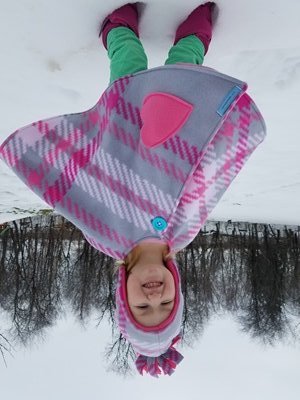 This second winter my daughter was becoming more independent and always wanting to walk rather than be carried, even on cold and windy winter days. I noticed that on a windy day her WarmMe would blow open when she was walking around outside. I decided to add something special that sets The WarmMe apart from other ponchos and kept my little girl warm even on windy days-by a special feature, interior pockets. The pockets on the inside allowed my daughter to keep her hands warm and also wrap The WarmMe around herself when she was wearing it outside of the car. Her second winter, my daughter loved her new and improved WarmMe with the added pockets. This was also when I decided to change the material from the sherpa to fleece. Fleece is much easier to work with especially when adding the pockets, has endless color and print combinations available, and is easily washable (a definite bonus when creating something for little kids!).
People stopped us all the time asking where were got The WarmMe and when I said I made it they started encouraging me to sell them. At this point in time I had two young children and was working part time as a school social worker, adding to a small business to my already full and busy life didn’t seem to make sense to me. Plus, my whole goal was to keep my daughters safe in the car, how could I put a price on that?
 In October 2015 my life changed. I suffered a traumatic miscarriage. As our dream of adding a 3rd baby to our family was crushed and I was left in the most physical and emotional pain I have ever experienced, I found myself needing something I was passionate about to get me out of the dark place I was stuck in. At this point I had made a couple WarmMes as gifts for friends and family and the feedback was great, they loved how much easier it made everyday life. That’s when I went for it, I decided to take a chance and put them up for sale, as I realized I could reach a lot of parents and caregivers who were looking for a safe way to keep their little ones warm. The business started very small, just a couple postings on my personal Facebook page that were then shared by my family and friends.
Each WarmMe has always been custom made based on the child’s clothing size and the print or color preference, so I just focused on completing each order as it came in. People soon started asking for added features such as an attached hood. After asking around and doing a little experimenting I decided a hood is just too bulky to be comfortable behind a child’s head and neck while riding in the car. I decided to start offering matching hats and they’ve been a hit! The next request was for matching scarves for the mom or dad and that option was quickly added in what I like to call the “Mommy and Me Set.”
In February 2016, The WarmMe was featured on a segment called “Moms a Genius” on WXYZ Detroit and the business picked up from there. I could no longer keep up with orders on my own, so my wonderful and supportive husband stepped in to help. In 2017, The WarmMe made the news again on my local news station WLNS 6 out of Lansing, MI and has been picked up by other stations in states such as South Carolina, North Carolina, W isconsin, Indiana, Minnesota, Ohio, New York, and Virginia. This holiday season The WarmMe has been sent to cold states all over the map. The best part of the increased business has been the feedback from happy customers. Almost daily I receive messages stating how much parents and children alike love The WarmMe and how it has made life easier by keeping little ones safe and warm! It is amazing knowing that my product is making life a little easier for parents, while keeping their precious little ones safe! I’m very happy to say that both The WarmMe business and our family are growing as we are expecting the newest addition to our family in January 2017!
HEALTHFUL HINTS:
- While the WarmMe is designed to young children safe and warm in their car seats, there are also products designed to fit safely over infant seats while not interfering with the ability to securely buckle the harness. These products are ones that do not go between the child and the car seat or buckles, but go over the seat similar to a shower cap.
- If taking a long road trip or traveling far from home when road or weather conditions are really bad (remember, I’m talking Michigan winters!) take along coats, snowpants, or snowsuits. If something were to happen and you ended up stranded these items would definitely help keep your little one warm until help arrived.
- Remember safe sleep precautions when using The WarmMe, similar products, or blankets to keep your child warm in the car seat. Always be sure the fabric is away from their face allowing for an open airway. If transferring a sleeping child from the car into their bed always remove The WarmMe.
- Here is the official Consumer Reports recommended “simple way to check if your child’s coat is too big and bulky to wear under their harness”
- Put the coat on your child, sit them in the child seat and fasten the harness. Tighten the harness until you can no longer pinch any of the harness webbing with your thumb and forefinger.
- Without loosening the harness, remove your child from the child seat.
- Take the coat off, and put your child back in the child seat and buckle the harness straps, which are still adjusted as they were when he was wearing the coat.
- If you can now pinch the webbing between your thumb and forefinger, then the coat is too bulky to be worn under the harness.
Senseez Pillows: Vibration to Relax, Calm & Soothe Little Bodies
 My name is Stephanie Mitelman. I am a Mom and I created the Senseez Pillows. The name Senseez means to ease the senses… Let me tell you the story of how Senseez was born…
When my son was 2, he was diagnosed with a special need. One of his difficulties was sitting in one place long enough to eat his meal, read a story, or sit for circle time.
I spoke to an occupational therapist who recommended a vibrating mat to help with this.I bought one for my son, and he instantly loved the sensations!
But one day, I wanted to take him to our local library for story telling, and though the mat would help… it was large, black, heavy, and had to be plugged in. I was also concerned about my son looking different or standing out with this large mat.
So I went on a search to find a small, lightweight, portable pillow that would offer the same sensations that he could take with him. I couldn’t find one!
So Senseez was born!
Senseez are colorful, lightweight, fun shaped vinyl pillows that offer a gentle vibration when they are squeezed or sat on. They operate on batteries and have a small pouch inside that can vibrate to offer sensations to relax, calm or soothe the body. They’re small enough to take anywhere and are made just for little bums!

Kids that have trouble sitting for meals, stories, car rides, shopping trips, school work, movies, or anything else will be comforted by the vibrations of Senseez. Kids that have trouble falling asleep will enjoy the relaxing sensations.
The original prototypes were sewn in the basement of our home! We made about 25 pillows by hand, and distributed them throughout schools and therapy centers in our area. Since Senseez was created to be taken everywhere and to be used by multiple children, we used a vinyl material, since it is considered to be the most hygienic and easiest to keep clean. The vinyl is also water resistant. We also created a Senseez furry option for children who would like more tactile input.
After we got some feedback, we hired an engineer to perfect the vibrating mechanism we needed. Once that was complete, we had the pillows tested by Canadian standards for lead, small parts and flammability.
We then connected with an importer who handled the production. Our first order was for 600 pillows. Once the word started getting out, we sold out within 9 months!
In April 2013, we were also invited to do a taping on the Dragon’s Den television show. Today, we have 14 different distributors across Canada and the US, and the pillows are now being used across schools, therapy centers and many homes! The feedback we get is so positive, and the ways in which the pillows are being used is so inspiring. Here is an example:
I wanted to share a positive story regarding your Senseez Pillows. I gave one of the pillows to my client who is part of our deaf blind program. Although she is very fluent in hand over hand sign language as well as Braille, she struggles a lot with expressive communication. We have been working closely with her to initiate requests, preferences, feelings…..communication in general. The pillow was introduced during a session as a sensory aid with vibration. She immediately started hugging the pillow and placing it behind her back ……all while signing the word “happy”.
While her expressive communication still remains a struggle, she is now on a regular basis asking for the “vibrating pillow”. She has created a sign that meshes together the words vibrate and pillow, which she independently will communicate to others!
It’s a huge break through!!!!!! It is the first time that she has communicated a want.
Needless to say, we will be needing some more pillows 🙂
Research shows that vibrational therapy has been used for many years in many different forms. Some children require the vibrations to help calm their bodies, while other children just enjoy the way it feels!
We are thrilled that our pillow is helping children, parents, teachers and therapists!
HEALTHFUL HINTS
Tips for working with children who have difficulty sitting in one place for any length of time:
- Some children do best with time limits. Let the child know how long they will have to sit for. A start and finish time can help. i.e: sit for 3 minutes to finish snack.
- Sometimes using a visual timer can help. Visual timers are available at most special needs stores.
- When training a child to sit for a period of time, start small and the build it up. One minute, goes to two, then five etc…
- It is okay to use outside reinforcers during this process. Children respond well to rewards, like their favorite treats. You want to build in a reward at the beginning and it won’t be long before long they won’t need it anymore.
- It is also okay to use other distractors like TV or iPad in the beginning. We want to calm the child during this hard task. For some children, TV and iPad can help reduce the anxiety of staying one place may cause. After a while, the distraction won’t be needed either.
- And you will need to verbally prompt at the beginning. Prompting is giving a gentle reminder about what the child is supposed to be doing, and reinforcing it when they do.
- It is always important to reinforce the good behavior (when they do sit in one place), and not only discuss when they don’t.
- And lastly, some children enjoy different sensations to help soothe their senses. Vibrations are helpful. Other sensations could be a weighted vest or blanket, or something that offers compression.
Note: Each child is different and you will have to experiment with what works with your child!
BreathableBaby Mesh Crib Liners: For Baby’s Safety AND Comfort
For more than ten years, parenting experts, child product safety organizations, and new parents have been talking about the potential safety hazards of using traditional crib bumpers inside infants’ cribs despite the benefits of preventing head, arm and leg injuries.
We are Dale and Susan Waters, married entrepreneurs from Minnesota who turned fear for our baby’s safety inside her crib into a mission to create something that would not only help protect babies but also provide peace of mind for parents. We invented the Breathable Mesh Crib Liner; a product designed to reduce the risks of suffocation caused by traditional bumpers, while protecting a baby’s limbs from becoming entrapped in the crib slats.
BreathableBaby is Born
 12 years ago, we woke to the sound of our 3-month-old daughter screaming in agony from her crib. Our daughter, Sierra had gotten her legs twisted and wedged between the slats of her crib. Her face was pinned against the mattress.
There were many sleepless nights for us and our daughter – no matter what we tried she kept getting her little arms and legs caught between the crib slats. In addition to the obvious pain of being stuck, we feared she would break an arm or leg, or develop neuropathy. But we refused to use a soft, pillowy crib bumper for fear of suffocation.
Research shows that a baby can snuggle up right against their crib bumper. If the baby’s nose and mouth are too close to the bumper, it can potentially cause dangerous re-breathing of carbon dioxide or suffocation. A baby can also get wedged between crib slats and the mattress, unable to escape and possibly suffocate. Because the safety and potential dangers of crib bumpers has been in the news recently, many parents are unsure about how to keep their babies comfortable and safe.
As parents, we were frustrated and upset to learn there was no practical solution available in the marketplace. As designers and entrepreneurs we decided we had to do something about it and devoted ourselves to developing a safer, “breathable” solution – preferably one that was affordable and easy to use. So, we took a break from the media, marketing and music company we owned, and focused on creating a safer solution for babies.
We researched and sourced fabrics, designed and engineered prototypes, held focus groups with mothers and sought extensive third party safety evaluations by a world-leader in safety consultation before finally introducing a safer, smarter mesh crib bumper to the market three years later in 2002.
 What makes BreathableBaby mesh crib liners so much safer is our Air Channel Technology™ (A.C.T.) designed to prevent suffocation. A.C.T. maintains air access should a baby’s mouth and nose press up against the fabric. When the BreathableBaby fabric is compressed it is virtually impossible to form an airtight seal.
Since its launch, we’re proud to say that the BreathableBaby™ brand has forged a new category in “breathable” bedding, and is embraced by parents worldwide. Our products have won numerous awards including The Child Safety House Calls Award of Excellence, and National Parenting Center Seal of Approval for innovation, functionality, design and contribution to creating a safer, healthier crib environment.
It’s imperative that parents are aware of the potential dangers that may be part of a baby’s sleep environment. New information is available all the time, so we urge all expectant parents – first time or otherwise – to seek relevant news, alerts, studies and guidelines from news and safety organizations such as the ones listed in our Healthful Hints below.
Wishing you and your little one sweet dreams.
HEALTHFUL HINTS:
Six Steps to a Safe Sleep Environment For Your Baby
- Crib Mattress Should be Firm. A soft mattress may increase suffocation risks. Select a firm mattress that fits the crib tightly and a fitted sheet. You should have a fitted not be able to fit more than two fingers between the mattress and the crib side. Before purchasing a crib, visit www.cpsc.gov to make sure the crib you selected has not been recalled.
- No Blankets for Baby. Do not place anything in baby’s crib that could be a suffocation hazard, including blankets. If you’re worried about keeping your baby warm, a better solution is an infant sleeper or wearable blanket that zips around your baby and can’t ride up over her face.
- Breathable Mesh Crib Liners. Crib bumpers that are plush, pillowy, and made of non-breathable fabric can increase the risk of suffocation. A safer crib option is one that is mesh or breathable and allows for air flow – even when pressed against a baby’s mouth.
- De-Clutter the Crib. For most parents, all those cute stuffed animals and soft blankets might seem a natural fit for the crib, but unfortunately they all pose suffocation risks. Toys and stuffed animals are best saved for interactive play time.
- A bottle. Parents of older infants who have started holding their own bottles may be tempted to slip a bottle into the crib in case their baby wakes at night. But even a bottle can pose a suffocation risk. Plus, babies who fall asleep with a bottle in their mouths are prone to tooth decay from the milk sugars that sit on their teeth all night.
- Pacifiers. Some studies have shown that giving your baby a clean, dry pacifier reduces SIDS rates.
Resources For More Information On Safe Sleep and Crib Safety
- Keeping Babies Safe www.keepingbabiessafe.org
- American Academy of Pediatrics www.healthychildren.org
- First Candle www.firstcandle.org
- Juvenile Products Manufacturers Association https://www.jpma.org/page/bsm_safety_tips
***************************************************************************************************************
Editor’s Note: So often with health and safety issues we have to make trade-offs between one risk and another: take a medicine to address a disease, but deal with the side-effects; exercise for health benefits but risk injuries. In the case of babies and cribs, parents have long had to make a trade-off between keeping babies safe from suffocation due to crib bumpers and protecting them from entanglement and injury in the crib slats. BreathableBaby mesh crib liners help parents address both these issues with peace of mind. We first ran this BreathableBaby post in 2011 and the company has continued to thrive, with additional products and awards to their credit.

