
Dealing With a Child Who Is Lying
 Today I had a very interesting incident with my almost 5 year old daughter. I had sent her to go brush her teeth in my bathroom and she was in there for a few minutes and I heard her say “What is that smell in here?” I thought maybe someone forgot to flush or something. When I went into the bathroom I caught my daughter sitting on the sink with a funny look on her face and then I was hit with the strong smell of tea tree oil. Apparently she had opened the top to the small bottle I had on my shelf and spilled some.
I asked her if she had opened the bottle and she immediately said “NO” with wide eyes. I of course KNEW she was lying to me, so I asked her again and told her to please tell me the truth. I really thought that she would say yes and admit to it and then I would give her a quick reprimand about touching my things and then move on to putting everyone to bed. Well, that was not the case. She just kept saying “no” each time I asked her. I then told her that she was going to be punished for lying to me and that she would not be able to have dessert after dinner tomorrow. Dessert lately (since Halloween) has been 1 small piece of candy. The kids look forward to this very much. But she still did not budge.
I had to put my other kids to bed and I really felt like just letting it go and having her go to bed – after all I had punished her so should be ok to let it go. But I felt very strongly about following through with the situation, so I told her to stay in the bathroom and wait for me while I put her brothers to bed. She was crying when I went back into the bathroom.
I sat on the floor in front of her and asked her again “Are you lying to me? Did you open my little bottle?” She just stared at me and didn’t answer. Then all of a sudden she blurted out that her little brother had done it. I was pretty shocked because I already knew she was lying and now she lied AGAIN. Isn’t it crazy how lying can actually cause blame and MORE lying? This happens with adults too! Gotta love the sin nature we have right?
Well, I went through the whole shpeal about how I  knew she was lying and how it is very important to tell the truth to mommy. I told her that there are consequences for lying. I told her that if she just tells the truth that she would not be in as much trouble, etc, etc. Then she quietly said “I’m scared”. I suppose she thought she would get in a huge amount of trouble for spilling the bottle and thought lying would help her to NOT get in trouble. I did more explaining and continued to ask her if she had opened the bottle. I wanted to stay consistent and not give up and just put her to bed without her admitting that she was lying. I thought that it was very important for her to come out and tell the truth to me. I spoke to her as lovingly as I could throughout our conversation.
I asked her one final time and she FINALLY shook her head yes that she had opened the bottle. Tears welled up in her big brown eyes. I told her that I was proud of her for telling the truth and I told her to come into my open arms for a hug. She melted on me and cried. I teared up as well and and asked her “what do you say to mama for lying?” And she sheepishly said “I’m sorry”. And I hugged her tight and told her that I forgave her and told her how much I loved her and reiterated the importance of always telling the truth.
I could’ve let the situation go and just punished her. I often do that with little things that happen such as fights between the kids or bad attitudes. I reprimand and punish and move on. But there is just something about lying that I think is soooo important to really be consistent in following through and helping a child to admit they are wrong. I did this with my oldest son a few years ago. He is now 6 and he has not openly lied to me since then. When I ask him to tell me the truth, he usually does the first time around. He learned that lesson through me taking the time to sit down with him during the first major lying episode, and doing the same with my daughter will hopefully prove to be a valuable lesson for her as well. I know some kids take more time to get things just because of their personalities, but the whole point is to be consistent with discipline and take the time out to talk to your child right away when things like this happen because it really pays off in the end.
How about you? Have you dealt with lying with your child? What did you do?
Bad Eating Habits Can Be Broken
Finding the right strategies to help you stop bad eating habits can be like trying to find the perfect pair of jeans: You may have to try on a bunch of different styles until you find the one that fits the best.
If you’re struggling with bad eating habits, you’re not alone. Most of us reach for not-so-good-for-us options from time to time. Here’s how you can break bad habits and feel better than ever.
1. Keep a food journal to avoid emotional eating.
Sometimes without realizing, we eat when we’re feeling anxious, depressed, sad, bored or even happy. Solving this common habit often requires some detective work in the form of a food journal. Write down what and how much you eat, identify emotional triggers, environmental situations and the intensity of hunger. Once you’ve pinpointed situations or feelings that lead you to eat, be proactive when these events occur. Instead of reaching for the pint of ice cream, bag of chips or whatever it might be, call a friend, do five minutes of deep breathing or head outside for a brisk walk.
2. Limit distractions to avoid overeating.
Do you typically eat your lunch at your desk while reading emails? Do you pick up your phone in the middle of a meal? Instead, limit distractions and get into the practice of focusing on the food you are eating. Turn off and put away cell phones, iPods, laptops and other electronics at mealtime. Prepare and eat more meals at home. And when you eat, sit at a table (not in front of the TV or on the sofa) and enjoy your food. You’ll eat less and make better food choices.
3. Get enough sleep to avoid weight gain.
Lack of sufficient sleep has been linked to weight gain and the risk of obesity. According to research at Johns Hopkins University, sleep deprivation impacts two hormones that influence hunger levels. An imbalance in the hormones, ghrelin and leptin, will cause sleep-deprived individuals to eat more and have less control over when to stop eating. If you find yourself extra tired on a given day, recognize the potential to overeat and prepare in advance. Plan meals ahead and pre-portion snacks. Resist the urge for caffeine late in the day, which can further interfere with sleep. Aim to get enough sleep each night — the average adult requires between 7 and 8 hours.
4. Practice mindful eating to develop lifelong healthy habits.
Poor eating habits and other health problems creep into our lives when we don’t take time to recharge. Schedule yoga or mediation in your daily or weekly routine to ensure time to focus on relaxation and breathing awareness. And give yourself mini breaks by simply shutting your eyes for a few minutes to take notice of your breathing before each meal. You will be more aware of your physical hunger, and that will allow you to slow down while you’re eating and make more conscious decisions about food.
Biting!!
Your beloved child is in a school situation for the first time and you’re just as proud as can be that there were  no major hitches and life goes on in a relatively uncomplicated manner. You’ve received good reports from his/her teachers and you have looked over the Picasso-like paintings and drawings he/she has faithfully brought home to you. Life is good!
Just then word reaches you. He/she has done what??? Did you say bite someone in the class? You ask with incredulity. That just can’t be, not our little baby; it has never happened at home… unless you count the time he/she bit the dog’s tail and received a growl as a reward and warning at the same time. But there it was just wagging in his/her little face, and what’s a little person going to do, commands to the pet do not even work when the adults try to enforce Rover’s poor manners. A bite seems to get a lot of attention from the pet and parents alike- seems like a good plan!
In fact, biting another individual does indeed get a lot of attention and a certain amount of infantile pleasure at having the capacity and strength to cause such an immediate reaction. Gee, just can’t think of anything that works better; of course a dirty diaper can get a similar reaction but not as dramatic, and when you consider the discomfort of sitting in that mess for a period of time before it is noticed, it sure isn’t the best method. So, call it readily accessible weapons, or the need for immediate gratification, but your child has found out the age old secret and is trying it on some unsuspecting child of his or her approximate size and strength.
OK, that’s the facts, now what can you do about it? Well, the first thing is not to bite back- we would expect that of the dog but not of a parent. After all if he/she urinated on you just after dressing for the day would you turn around and reciprocate? Of course not so we need to develop a method that is civilized, explanatory, and requires some punishment if it persists.
First of all, I’ve found that you need to catch the child in the act, but if my experience holds true, the little devil will attempt this at home at some point. There are no studies to support my method of dealing with this issue except the good responses I receive from parents who are only too happy to stop this habit- FAST! There must be an immediate loud, forceful verbal “NO” (which it is almost impossible to suppress) followed in short order by a light flick to the side of the lips/mouth with one of your fingers. I’ve found this to be shocking enough for an immediate release to occur, but not forceful enough to cause any local damage. Your child will get the picture fairly quickly that this behavior is certainly something that should not and will not be repeated. Stick with it parents, it won’t take long and the problem will be gone.
Toddler Doesn’t Have to Mean Temper Tantrums
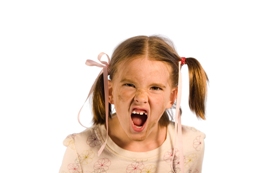 Yelling. Fighting. Hitting. Tantrums. Biting. Sound familiar? They are all typical behaviors bad-tempered kids use to make their needs known and to get their way. But here’s a critical parent secret: Hot tempers are learned so they can be unlearned. And calming a hot temper is not only doable but also essential for growing up in this sometimes violent, unpredictable world. Here are six anger management tips from The BIG BOOK OF PARENTING SOLUTIONS.
- Commit to raising a controlled kid. Studies show that parents who feel strongly about their kids showing self-restraint succeed because they committed themselves to that effort.
- Model coolness. One question parents should ask nightly is: “If my kid had only my behavior to watch, what would he have seen today?” Self-control is learned first at home.
- Set a rule: “Talk only when calm.” Refuse to talk to your kid until you and your kid are calm. If needed, lock yourself in the bathroom. Enforce the EXIT rule: walk away until calm.
- Identify stress signs. We all have unique physiological stress signs warning us we’re getting angry: flushed cheeks, rapid breathing, dry mouth. Recognize your child’s signs and help him identify them and keep pointing them out until he recognizes them in himself.
- Teach your child healthy ways to control that bad temper. Here are a few options:
- Use self-talk. Teach him an affirmation: a simple, positive message he says to himself in stressful situations. For example: “Stop and calm down,” “Stay in control,” “I can handle this.”
- Tear anger away. Tell your child to draw or write what is upsetting him on a piece of paper. Then tear it into little pieces and “throw the anger away.”
- 1 + 3 + 10. As soon as you feel you’re losing control: 1. Tell yourself: ‘Be calm.’ 2. Take three deep, slow breaths. 3. Count slowly to 10. Together it’s 1 + 3 + 10.
- Abdominal breath control. Inhale slowly to a count of five, pause two counts, slowly breathe out, again counting to five. Repeating the sequence creates maximum relaxation, and reduces stress.
- Use the “Rule of 21.” The trick is to find a strategy that matches each kid’s unique temperament and comfort level. It will only become a habit if it is practiced until automatic and usually that’s 21 days!
****************************************************************************************************************************
Dr Borba’s new book The Big Book of Parenting Solutions: 101 Answers to Your Everyday Challenges and Wildest Worries, is one of the most comprehensive parenting book for kids 3 to 13. This down-to-earth guide offers advice for dealing with children’s difficult behavior and hot button issues including biting, tantrums, cheating, bad friends, inappropriate clothing, sex, drugs, peer pressure and much more. Each of the 101 challenging parenting issues includes specific step-by-step solutions and practical advice that is age appropriate based on the latest research. The Big Book of Parenting Solutions has recently been released and is now available at amazon.com

