
Counting Our Blessings: Proven Ways to Raise a Grateful Child
Last updated on December 9th, 2024 at 12:45 am
It’s Christmas Day…or the first night of Chanukah…or maybe it’s Thanksgiving… and your family and guests are all gathered together at your table ready for the meal to begin, but you first want folks to share their blessings. Be honest. Which scenario would best depict your reaction when it’s your children’s turn to count their blessings with the group? Would you…
 A. Beam with pride as they describe their gratitude for their life blessings?
B. Gently remind them of things they could share?
C. Want to die from embarrassment since your kids can’t think of anything to say?
If your kids need reminders to say “thank you”, show appreciation or take for granted thoughtful gestures, then it may be time for a gratitude makeover. Here’s another reason to do so: Studies prove that the happiest kids feel an appreciation for life—and that’s regardless of their wealth or personal circumstances. They are also more joyful, determined, optimistic, resilient, less stressed and even healthier. So if you’re a tad concerned that your kids’ attitude of gratitude needs a little boost, the good news is that science also proves there are simple strategies to do so. One of the easiest ways is by establishing family rituals where kids count their everyday blessings.
Here are a few to get you started:
- Thank You ABCs. This one is great for younger kids to do at the dinner table. You and your kids say the alphabet together but for each letter include something you are grateful for: A, Aunt Helen; B, my brother; C, my cat, and so on. Take it up a notch by explaining why they are grateful. Families with small kids rarely get beyond H, but the point is you’re having fun together and you kids are also learning to be appreciative.
- Holiday blessings. Say a prayer of thanks together before meals. Some families take turns so that each night a different member leads the prayer. Or do bedtime blessings when each child exchanges messages of appreciation for one another followed by a goodnight hug and kiss.
- Gratitude letters. Your child writes a letter to someone who has made a positive difference on his life but has probably not thanked properly in the past (such as his teacher, coach, scout master, grandparent). To maximum the impact, research says that your child should read the letter to the person face to face.
- Set limits. Having too much squelches appreciation. So fight the tendency to overindulge your child with too many things. Always giving kids what they want does not help kids learn to be grateful and appreciative of what they have.
- Gratitude journals. Another proven way to boost gratitude is by having your kids write something they feel grateful ideally four times a week and continue for at least for three weeks. Younger kids can draw or dictate things they are most grateful for; older kids can write in a diary or in a computer. Why not do so as a family?
- Thank your kids. Don’t overlook your kids’ daily thoughtful deeds. Just be sure to tell them what they did that you appreciate so they are more likely to copy your example and send their own “appreciation messages” to others.
- Expose your kids to the less fortunate. Face-to-face experiences can go a long way in helping kids appreciate their blessings. So find ways for you and your child to do charitable work (playing with kids in a homeless shelter, reading to the blind, building low-cost house, or delivering meals for the bed-ridden).
Remember, change is a process not a one-time activity. So stick to your commitment and find simple ways to help your child practice gratitude, reinforce any efforts and don’t give up until you get the desired change.
Happy Holidays!
****************************************************************************************************************************
Dr Borba’s book The Big Book of Parenting Solutions: 101 Answers to Your Everyday Challenges and Wildest Worries, is one of the most comprehensive parenting book for kids 3 to 13. This down-to-earth guide offers advice for dealing with children’s difficult behavior and hot button issues including biting, tantrums, cheating, bad friends, inappropriate clothing, sex, drugs, peer pressure and much more. Each of the 101 challenging parenting issues includes specific step-by-step solutions and practical advice that is age appropriate based on the latest research. The Big Book of Parenting Solutions is available at amazon.com
Sniffle-Fighting Snacks for You and Your Kids
Last updated on December 9th, 2024 at 12:44 am
 Ah, fall. The leaves are changing, the mercury is dropping and … the air is filling with the sound of sneezes and coughs. With the average kid coming down with a cold eight to 10 times a year, it’s no wonder that you’re trying your hardest to keep your family healthy.
Along with enforcing hand-washing rules, also try adding immune-boosting nutrients. Snacks are the perfect opportunity to sneak in an extra serving, so stock up on the following foods – so you can sidestep those sniffles this season.
1. Yogurt: This creamy treat is packed with healthy probiotics, the “good” kind of bacteria. According to a study published in the British Journal of Nutrition, students who had a probiotic drink daily for three months as half as many sick days as those who got a placebo drink.
2. Oats: A bowl of oatmeal is a quick and filling snack. Plus, oats are high in beta-glucans, a compound that can fend off the sniffles. According to German scientists, those who were given beta-glucan daily for 26 weeks had 13 percent fewer sick days than those who weren’t. Want your kids to gobble up their oats? Bake them into delicious low-fat cookies.
3. Pumpkin seeds: Half a cup of these crunchy seeds deliver 41 percent of all of the zinc you need in a day. Research shows that zinc may stop viruses from spreading in the body, shortening the duration of the cold or flu. Try mixing them into yogurt, adding them to trail mix or whipping up a homemade granola bar, such as this five-minute recipe.
4. Berries: Not only are they high in vitamin C, but berries are also loaded with antioxidants. These nutrients protect against the damage that can wear down the immune system. Eat those berries out of hand, or add them to that bowl of yogurt or oatmeal.
5. Tea: Whether you prefer green or black, or iced or hot, brew up some benefits with this drink. In a study from Harvard University, people who sipped black tea for two weeks had 10 times the amount of a cold-fighting protein called interferon than those who didn’t. Experts believe that a type of antioxidants in tea, catechins, may kill of viruses. So put on that kettle!
6. Spinach: It’s no secret that this dark leafy green is good for you. But it packs a particular punch against colds, containing vitamins C, E and B6 – three nutrients shown to rev up your immunity. Can’t get your kids to eat spinach? Think again: Try whipping up a tasty smoothie from a frozen banana, orange juice and a handful of spinach. Except for the green color, they won’t even realize they’re sipping up their greens!
The WarmMe: The Safe Car Seat Winter Coat Alternative
Last updated on July 6th, 2025 at 03:26 pm
 In the Winter of 2012, I found myself as a first time mom of a beautiful 6 month old baby girl and I had a problem. We had moved my daughter out of her infant car seat and into a convertible car seat, she was just too heavy to carry around in the infant seat. The problem was it was winter and I didn’t know how to keep her warm while also keeping her safe in her new seat. I had read many articles and seen many graphics online about the dangers of using a winter coat under the straps of car seat harness.
A winter coat is too bulky to safely and securely use under a car seat harness. We did the quick test suggested in multiple articles, put the child in their coat and secure the harness straps, tightening them until they feel snug, then take the child out of the seat and remove their coat, put them back in and buckle the straps. We were shocked by the results, we were certain the straps had been tight when the coat was one, but once the coat was removed there was so much slack in the straps! In the case of a car accident, the force from the accident would cause the child’s winter coat to compress against the straps and the result would be gaping, loose straps that a child could slip through. More recently (January 8, 2024), Consumer Report issued a report and video on this exact danger. They suggest removing the child’s coat and putting it over them like a blanket once they are secured in the car seat, or using a blanket to cover the child.
 So, how would we keep our little girl warm throughout a cold Michigan winter? We tried multiple options including putting her coat or snowsuit on in the house and removing in the car then putting it over her once she was buckled. We tried layering blankets over her once she was buckled. We tried lightweight sweatshirts under the straps. None of these options were convenient or warm, taking the coat on and off was probably the most time consuming, the blankets didn’t stay on, and the sweatshirts just weren’t warm enough. That’s when I knew there had to be a warm and safe alternative to the winter coat. I decided to make something as warm as a blanket that would stay on without the need for removing in the car. I thought that something like a poncho would work the best, and so the first version of the The WarmMe was born.
The first version of The WarmMe was very basic, it kept my daughter warm and safe in the car, so it served it’s purpose but I felt there were improvements that could be made. The WarmMe had a single button on the front to secure it and made opening the front simple and easy for securing the car seat harness underneath. The first WarmMe was made of a fleece lined sherpa material that was cute and cuddly, but pricey plus very limited on color selection. The WarmMe worked well that first winter, so the next winter I made an identical one that was just a bit larger to fit my quickly growing daughter.
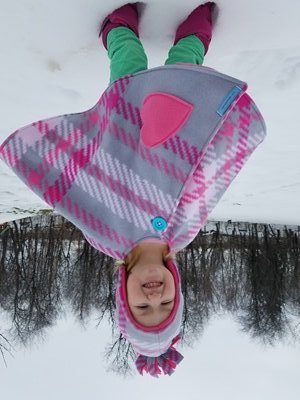 This second winter my daughter was becoming more independent and always wanting to walk rather than be carried, even on cold and windy winter days. I noticed that on a windy day her WarmMe would blow open when she was walking around outside. I decided to add something special that sets The WarmMe apart from other ponchos and kept my little girl warm even on windy days-by a special feature, interior pockets. The pockets on the inside allowed my daughter to keep her hands warm and also wrap The WarmMe around herself when she was wearing it outside of the car. Her second winter, my daughter loved her new and improved WarmMe with the added pockets. This was also when I decided to change the material from the sherpa to fleece. Fleece is much easier to work with especially when adding the pockets, has endless color and print combinations available, and is easily washable (a definite bonus when creating something for little kids!).
People stopped us all the time asking where were got The WarmMe and when I said I made it they started encouraging me to sell them. At this point in time I had two young children and was working part time as a school social worker, adding to a small business to my already full and busy life didn’t seem to make sense to me. Plus, my whole goal was to keep my daughters safe in the car, how could I put a price on that?
 In October 2015 my life changed. I suffered a traumatic miscarriage. As our dream of adding a 3rd baby to our family was crushed and I was left in the most physical and emotional pain I have ever experienced, I found myself needing something I was passionate about to get me out of the dark place I was stuck in. At this point I had made a couple WarmMes as gifts for friends and family and the feedback was great, they loved how much easier it made everyday life. That’s when I went for it, I decided to take a chance and put them up for sale, as I realized I could reach a lot of parents and caregivers who were looking for a safe way to keep their little ones warm. The business started very small, just a couple postings on my personal Facebook page that were then shared by my family and friends.
Each WarmMe has always been custom made based on the child’s clothing size and the print or color preference, so I just focused on completing each order as it came in. People soon started asking for added features such as an attached hood. After asking around and doing a little experimenting I decided a hood is just too bulky to be comfortable behind a child’s head and neck while riding in the car. I decided to start offering matching hats and they’ve been a hit! The next request was for matching scarves for the mom or dad and that option was quickly added in what I like to call the “Mommy and Me Set.”
In February 2016, The WarmMe was featured on a segment called “Moms a Genius” on WXYZ Detroit and the business picked up from there. I could no longer keep up with orders on my own, so my wonderful and supportive husband stepped in to help. In 2017, The WarmMe made the news again on my local news station WLNS 6 out of Lansing, MI and has been picked up by other stations in states such as South Carolina, North Carolina, W isconsin, Indiana, Minnesota, Ohio, New York, and Virginia. This holiday season The WarmMe has been sent to cold states all over the map. The best part of the increased business has been the feedback from happy customers. Almost daily I receive messages stating how much parents and children alike love The WarmMe and how it has made life easier by keeping little ones safe and warm! It is amazing knowing that my product is making life a little easier for parents, while keeping their precious little ones safe! I’m very happy to say that both The WarmMe business and our family are growing as we are expecting the newest addition to our family in January 2017!
HEALTHFUL HINTS:
- While the WarmMe is designed to young children safe and warm in their car seats, there are also products designed to fit safely over infant seats while not interfering with the ability to securely buckle the harness. These products are ones that do not go between the child and the car seat or buckles, but go over the seat similar to a shower cap.
- If taking a long road trip or traveling far from home when road or weather conditions are really bad (remember, I’m talking Michigan winters!) take along coats, snowpants, or snowsuits. If something were to happen and you ended up stranded these items would definitely help keep your little one warm until help arrived.
- Remember safe sleep precautions when using The WarmMe, similar products, or blankets to keep your child warm in the car seat. Always be sure the fabric is away from their face allowing for an open airway. If transferring a sleeping child from the car into their bed always remove The WarmMe.
- Here is the official Consumer Reports recommended “simple way to check if your child’s coat is too big and bulky to wear under their harness”
- Put the coat on your child, sit them in the child seat and fasten the harness. Tighten the harness until you can no longer pinch any of the harness webbing with your thumb and forefinger.
- Without loosening the harness, remove your child from the child seat.
- Take the coat off, and put your child back in the child seat and buckle the harness straps, which are still adjusted as they were when he was wearing the coat.
- If you can now pinch the webbing between your thumb and forefinger, then the coat is too bulky to be worn under the harness.
Election 2024: Are Our Fears Becoming Our Kids’ Phobias?
Last updated on November 17th, 2024 at 03:22 pm
 “She should be impeached”… “if he is elected millions will be deported”… “no-one will be able to afford healthcare”… “our country will be bankrupt”…“if he”… “if she”…
More than any other time in recent history, Election 2024 is showing us a country divided – one that is filled with anger and hostility and fear – and our children are bearing witness. Depending on their backgrounds some of them are scared about their immigration status, or their parents having jobs, or our country being a safe place to live, or even having enough money to eat …all depending on “who wins”. The questions are unending and appear everywhere they turn. All these know is their parents are afraid, and that is enough to rock their foundation. This is a turning point for this generation. If we want to create a culture of kindness, we need to fix this…before today’s fear become lifetime phobias for our kids.
When is a worry or a fear actually a phobia and what is the difference?
Fears are common and expected in childhood; however, for some children and teens, their fears can become very severe over time, and even develop into a phobia. A phobia is an intense, unreasonable or exaggerated fear of a specific object or situation.
How common are phobias in childhood?
- On average, specific phobias begin in childhood, between seven to eleven years with most cases starting before age ten.
- Approximately 5% of children and 16% of adolescents will have a specific phobia in their lifetime.
What causes phobias?
A child may have a phobia of something specific dogs, spiders, or snakes, for example. Research suggests that phobias may run in families. Both genetic and environmental factors (life experience) can contribute to developing a phobia.
Some children and teens develop a phobia after being exposed to a traumatic or frightening event. Their concerns begin as rational, a natural reaction to a frightening event. But when the child catastrophizes the event or does not have the thinking skills to cope with or understand the event, sometimes the fear becomes larger than the situation warrants.
How do fears and phobias affect children, as they grow older?
If a child is not helped to understand the fear and the meaning of the worry, he may feel powerless and thus may worry more. The key is to help the child feel powerful over his thoughts, feelings and experiences. The more coping skills he has, the better he will do as he grows up.
Children often fear something because they think it will cause pain or from a previous experience, should a parent push their child to overcome their fear or let it happen over time?
Research shows that children are not usually reassured out of phobias. It’s best to help your child become an expert in their own anxiety and worries. Help your child develop the analytic skills to think about their phobias in a new way. Make them “cognitive scientists.” Encourage them with thoughtful conversations that aid them in helping their brains to be calm in light of distressing experiences. Help them explore their fears or worries and then empower them to develop new thoughts, feelings and behaviors regarding their fears. Here are a few conversation starters to spark your engagement.
- What makes you worried?
- What do you think when you are worried?
- What do you fear will happen?
- How is your brain responding to your fears or worries?
- How BIG is your worry?
- How big is the “true threat” of what worries you?
- How can we “think differently” about this fear?
- What else can we say to ourselves?
- How can you help your brain calm down?
- How can you help your brain see this fear differently?
- What can you say to yourself when you begin to feel worried?
- What can you do to calm yourself down?
- How can I help you best when you feel worried?
What is a way to change a child’s fear around and look at it as a positive?
Slowly facing the fear or worry in a safe way, builds up a sequence of new life experiences that may aid your child in developing a new perspective.
Help your child with a strategy that aids your child in evaluating the size of the true threat compared with the size of the worry. Using thermometers or balls can help in this regard. You are helping your child see how BIG the worry is.
Here is a helpful printable from our book 70 Play Activities. The election provides a real-life platform to encourage skills-based conversations with your children. So help them to think, explore, converse and problem solve instead of simply getting “caught in their worries.”

As an example, if you live in Minnesota and your child will not go out for fear of snow, it’s important for your child to know that snow is made of water, so it melts. Snow rarely causes direct damage. Help them enjoy the snow by building, playing and even bringing the snow inside for science experiments. Talk about how BIG is their worry? Using the activity to draw, write and narrate their concerns.
Remember, phobias are “overgrown fears.” They are bigger than reality dictates. You can help your child shrink those fears down to size with collaboration and communication.
For more help on phobias here are a few books you might take a peek at.


*********************************************************************************************************************
 Written for teachers, educators, and clinicians whose work involves playing, talking or teaching children who would benefit from better executive function and social-emotional learning skills, 70 Play Activities incorporates over 100 research studies into printable worksheets, handouts, and guided scripts with step-by-step directions, to empower children to learn and behave better. “With 70 Play Activities we aim to improve the trajectory of children’s learning by integrating the newest neuroscience with activities children love!” With over 70 activities designed to improve thinking, self-regulation, learning and behavior, your tool-kit will be full and your creative brain will be inspired to craft your own meaningful exercises. 70 Play Activities is available at amazon.com
4 Essential Sleep Habits for Kids
Last updated on November 17th, 2024 at 03:22 pm
 A good night’s sleep for grade-schoolers and teens means at least 9 hours of solid shut-eye, according to the National Institute of Health. For preschoolers, it’s 10-13 hours, and for babies it’s up to 17. But many kids are falling short … and paying the price.
New research from The University of Chicago suggests that youngsters who don’t get enough rest are more than four times as likely to be obese as their well-rested counterparts; sleep deprivation has been shown to disrupt levels of chemicals that regulate appetite. And Spanish researchers recently found that kids who don’t log an adequate amount of shut-eye are more likely to struggle in the classroom, where poor sleep habits hinder their motivation and compromise their ability to concentrate, memorize, write and spell.
One of the biggest sleep-snatchers is electronics, according to Timothy F. Hoban, director of pediatric sleep medicine at the University of Michigan Medical Center. “Thirty years ago, there were no game systems, personal computers or mobile phones. This technology is now commonplace and often available in the child’s own room,” he says. But bad sleep habits are also to blame.
Here are Hoban’s top tips for getting your kids’ sleep situation under control:
- Keep a regular bedtime schedule: Not just on school days, but seven days a week. “Children who are weekend night owls or sleep in on the weekends will often have a very different sleep pattern than they do on weekdays, increasing the likelihood for insomnia during the week and making it more difficult for them to fall asleep at an appropriate time on school nights,” says Hoban.
- Establish and follow a regular bedtime routine: Easing the transition to nighttime sleep is almost as crucial for older kids as it is for young ones. About 15-30 minutes before bedtime, try to establish a calm atmosphere in the house. Pry kids away from electronics and encourage them to chill out for a while and read. Make it clear that computers, handheld games and phones must be turned off for the night.
- Balance and prioritize: After-school activities are great. But if your child is so overscheduled that she’s up late doing homework and tossing in bed over all she has to do, it’s time to identify what’s really important … and eliminate the activities that aren’t.
- Walk the walk: No need to hit the sack at 8 p.m. However, parents who have regular sleep patterns and healthy sleep habits are important role models for their kids. That means not keeping the house hopping till the wee hours on an ongoing basis. And maybe even moving the television out of your bedroom. You might just end up better-rested yourselves.
It’s Fall and My Child Won’t Stop Sneezing – Ask a Pediatrician
Last updated on October 23rd, 2024 at 05:50 pm
 Just when you and your children have made it through the summer with all the allergic sneezing and coughing seen mostly at the beginning of the summer, Fall arrives and is ushered in by ragweed season. Here we go again: watery itchy eyes, sneezing, runny itchy nose, etc. Now throw in the contact between children of like ages occurring in school rooms across the country and what is a parent to think? Is this allergy, or might it be a cold? Good question, but in fact it makes very little difference if your child is otherwise healthy and feeling well.
While it is true you will begin to see infectious agents causing this situation, this is a child who need not be kept out of school and who need not necessarily be given any medicine to “cure the cold” (there are no existing medicines to cure a cold). There is a certain period of being contagious regardless of the effects of medicines on the symptoms for every infectious disease. In school aged children most of these illnesses are viral in nature and are very similar in their symptoms to allergic issues.
The contagious period often begins before the symptoms begin and are unaffected by the use of medications!
Regardless what many parents believe, I truly believe that “treatment” is only needed if the symptoms appear to be greatly influencing the life of the child; that is, interfering with appetite, sleeping, playing or school work. Unless that occurs, one is treating insignificant symptoms, such as cough, or fever and more to the advantage of the parents than the child. All medications have side effects and the over-the-counter cold preparations usually contain several medications of differing pharmaceutical classes; each designed to relieve a certain symptom, e.g. cough, runny nose, fever, etc. Most of the time your child does not need all features of these medications (but that’s the only way it comes) and side effects can occur.
Add to that the fact that even using the exactly correct medicine for the symptom, the over-the-counter medication is not liable to achieve the desired result. Also a good proportion of symptoms at this time of year may be allergy related and will respond even poorer to the over the counter cold medicines.
Other posts will deal with such issues as fever and use of antibiotics, but for now, you should be equally concerned about what goes into your child’s body whether that is foods or relatively useless medicines. Remember, as a parent, whether you sleep well at night or not is not as important as whether your child is perfectly comfortable even though there may be an annoying cough that you are listening to very intently all night.
You’re tired and yes you’re annoyed (it’s OK to be annoyed) but when you tentatively venture into your child’s room, most likely you’ll find he/she is sleeping, well, like a baby.

