
New Research into the Impact of Digital Media on Homework
Last updated on November 14th, 2016 at 11:38 am
How does the amount of time spent on digital media affect a child’s well being and development, including the ability to complete their homework? New research provides additional insight into this question.
 THE PROBLEM: In today’s ever-changing world of technology, how does a parent deal with the pressures of time constraints? When all around you, people are no longer communicating with each other without some kind of digital screen in front of them, how do you make a decision about how much digital media is okay for your child? When does it become too much, so that it interferes with the other facets of a child’s healthy emotional and mental development?
THE STUDY: That was the question that pediatricians from Brown University School of Public Health sought an answer to when they analyzed data on media use and homework habits of 64,000 children aged 6-17 from the 2011-2012 National Survey of Children’s Health. This survey, which uses parental and caregiver reports of their children’s activities, is sponsored by the federal Maternal and Child Health Bureau and completed every few years by a group at the Centers for Disease Control and Prevention. The researchers presented an abstract of the study, “Digital Media Exposure in School-Aged Children Decreases the Frequency of Homework”, at the American Academy of Pediatrics National Convention in October.
Overall findings were specific and abundantly clear: “Children who spent four to six hours on digital media had 49 percent lower odds of always or usually finishing their homework than those with less than 2 hours per day.” Even 2 or 3 hours a day resulted in a significant negative impact on homework completion.
Note: “Digital media” included: TV, computers, tablets and smartphones, and the research separated out time spent on school work projects.
Facts: Percentage of digital media exposure of the study group.
- 31% were exposed to less than two hours per day.
- 36% were exposed to two to four hours per day.
- 17% were exposed to four to six hours per day
- 17% were exposed six or more hours per day
THE RESULTS: The effects of digital media exposure on homework completion by children, when compared to children with less than two hours of usage per day:
- Two to four hours of media usage: children had 23% lower odds of completion.
- Four to six hours of media usage: 49% lower odds of always or usually finishing their homework.
- Six or more hours of media usage: 63% lower odds of completion.
- For every additional two hours of any digital media usage, there was significant decrease in the probability of always or usually completing homework.
Other negative side effects of over-exposure to digital media and the ability for children to flourish, surfaced in the lack of
- Caring about performing well in school
- Completing tasks started
- Interest in learning new things
- Staying calm in the face of challenges
“Parents should consider these combined effects when setting limits on digital media devices.” according to Stephanie Ruest, MD, FAAP, an author of the study.
Note: The statistics remained the same regardless of child’s age, sex or family income level.
MY THOUGHTS: As a Grandmother of five grandchildren between the ages of eleven and fifteen, I have certainly had the opportunity to observe the problem many times over – and from my perspective, the bottom line is clear. Parents need to pay attention to this study.
They need to make the adjustments to their parenting by not following a “Do as I say, not as I do!” mentality. The study quite clearly answers the question: Yes, there will be damage to children from long-time exposure to digital media. The more the exposure, the more the damage there will be. It WILL have a negative effect on their ability to complete their homework and other projects, get a good night’s sleep and to remain calm in the face of a crisis. The parents are the examples. Will they be willing to make the changes in their own and their family’s lives to be able to nurture stable, responsible, well-adjusted children by making the harder, more adversarial choice to limit their child’s usage of digital media?
Reference
The abstract was presented by co-author Max Rubinstein, MD., a copy of which can be obtained from the AAP Department of Public Affairs at: commun@aap.org. Senior author Annie Gjelsvik, PhD, can be contacted at Annie_Gjelsvik@Brown.edu.
Click here for a link to an AAP article on this study.
Making Healthy Packed Lunches for Your Back-to-School Kid
Last updated on August 22nd, 2016 at 04:33 pm
 It’s just as important to make sure the lunchbox your child takes to school provide a healthy, balanced lunch as when they eat at home.
This means plenty of foods that contain the nutrients that children need, and fewer foods that are high in sugar and saturated fat.
You can learn the healthy foods basics in Good food and diet.
Packing the Lunchbox
A balanced packed lunch should contain:
- Starchy foods. These are bread, rice, potatoes and pasta, and others.
- Protein foods. These are meat, fish, eggs, beans and others.
- A dairy item. This could be cheese or yoghurt.
- Vegetables or salad, and a portion of fruit.
Starchy foods are a good source of energy, and should make up a third of the lunchbox. But don’t let things get boring. Instead of sandwiches give kids bagels, pitta bread, wraps and baguettes. Use brown, wholemeal or seeded bread, not white bread.
Get ideas for healthy starchy foods.
Children often like food they can eat with their fingers, so chop up raw veggies such as carrots or peppers, and give them houmous or cottage cheese to dip the veggies in. Breadsticks and wholemeal crackers are great finger foods and they can be spread with low-fat soft cheese or eaten with reduced-fat cheddar and pickles.
Replace chocolate bars and cakes with fresh fruit, dried fruit.
Vary the fruit each day and get them to try new things, like kiwi or melon.
Unsalted nuts are a great snack food for children to have at home, but it’s best to leave them out of your child’s packed lunch. Many schools ban nuts to protect pupils with a nut allergy.
Here are more ideas for healthy food swaps.
You could also make up a tasty fruit salad. Be inventive and encourage your children when they try something new.
Making Healthier Food
It may take a while for your children to get used to a healthier lunchbox. But it will be worth it for their health, so keep trying.
You can help by eating a wider range of foods at home, as a family. For ideas on how to introduce more fruit and vegetables into your family’s diet, read 5 A DAY and your family.
Reading supermarket food labels can help you to buy healthier foods for your child’s lunch, and for family meal times. Learn more in Buy healthier food.
Save chocolate and cakes for occasional treats. Remember to praise your child when they’ve tried something new, to show your encouragement.
You can find lots of ideas for healthy lunches at Change4Life: healthy lunchbox ideas.
Lunchbox Ideas
There are more ideas for healthy packed lunches from the Children’s Food Trust.


Back to School Safety Tips…for Parents of Gen Z
Last updated on June 5th, 2018 at 02:57 pm
 Summer is winding down and a new school year is right around the corner. A new school year can bring changes in routine and even the schools themselves.
The following is a list of safety tips we have compiled and distributed for back to school time and may serve as a nice guide or refresher to help us all get back into our school year routine.
School Zone Driving Safety Tips
- Be on the lookout for school zone signals and ALWAYS obey the speed limits.
- When entering a school zone, be sure to slow down and obey all traffic laws.
- Always stop for school busses that are loading or unloading children.
- Watch out for school crossing guards and obey their signals.
- Be aware of and watch out for children near schools, bus stops, sidewalks, in the streets, in school parking lots, etc.
- Never pass other vehicles while driving in a school zone.
- Never change lanes while driving in a school zone.
- Never make U-Turns while driving in a school zone.
- Never text while driving in a school zone.
- Avoid using a cell phone, unless it is completely hands-free, while driving in a school zone.
- Unless licensed to do so, never use handicap or emergency vehicle lanes or spaces to drop off or pick up children at school.
- Please look out for kids with their head down, looking at the phone and not at the street they are crossing.
Riding Your Bike to School
 Check with the school to make sure your child is allowed to ride their bicycle to school. Some schools do not allow students to ride bicycles to school until they reach a specific grade.
- Make sure your child always wears a bicycle helmet! Failure to wear one could result in a traffic citation. Furthermore, in the event of an accident, helmets reduce the risk of head injury by as much as 85 percent.
- Obey the rules of the road; the rules are the same for all vehicles, including bicycles.
- Always stay on the right-hand side of the road and ride in the same direction as traffic.
- Be sure your child know and uses all of the appropriate hand signals.
- Choose the safest route between home and school and practice it with children until they can demonstrate traffic safety awareness.
- If possible, try to ride with someone else. There is safety in numbers.
Playground Safety
- MA supervisor must always be present when children are at the school’s playground. Make sure your school has someone who monitors the playgrounds at all times.
- Playground equipment should be surrounded by shock-absorbing material that is at least nine inches thick.
- Protective surfaces should extend six feet in all directions around the playground equipment. For swings, it should extend twice the height of the set.
- Due to strangulation hazards, do not attach ropes, jump ropes, clotheslines, pet leashes or cords of any kind to playground equipment.
- Be watchful of sharp edges or points on equipment.
- Alert the school if you notice anything strange about the playground equipment at your child’s school.
- Spaces that can trap children, such as openings between ladder rungs, should measure less than three and a half inches or more than nine inches.
- All elevated surfaces, such as ramps, should have guardrails to prevent falls.
Walking to School
 Leave early enough to arrive at school at least 10 minutes prior to the start of school.
- Use the same route every day and never use shortcuts.
- Go straight home after school. Do not go anywhere else without permission.
- Always use public sidewalks and streets when walking to school.
- Demonstrate traffic safety awareness and pick the safest route between your home and the school and practice walking it with your children.
- Try and walk to school with other students. There is strength in numbers.
- Teach your children to recognize and obey traffic signals, signs, and pavement markings.
- Only cross streets at designated crosswalks, street corners and traffic controlled intersections.
- Always look both ways before crossing the street and never enter streets from between obstacles like parked cars, shrubbery, signs, etc.
- Always walk and never run across intersections.
- Avoid talking to strangers. Teach your children to get distance between themselves and anyone who tries to approach or make contact with them.
- If a stranger does approach your child, make sure they know to immediately report the incident to you or a teacher.
- Teach your children to never get into a vehicle with anyone, even if they know them, without your permission.
Clothing and School Supplies
- To prevent injury, backpacks should have wide straps, padding in the back and shoulders, and should not weigh more than 10 to 15 percent of a child’s body weight.
- When placing items in a backpack, place the heavier items in first. The closer the heavier items are to a child’s back, the less strain it will cause.
- Children should use both backpack straps and all compartments for even distribution of weight.
- Remove drawstrings from jackets, sweatshirts, and hooded shirts to reduce the risk of strangulation injuries.
- Art supplies in the classroom should always be child safe and non-toxic. Be sure they have “CONFORMS TO ASTM D-4236” on their packaging.
- Make sure your child’s school is up-to-date on the latest recalled children’s products and toys.
School Bus Safety
- Make habit of arriving at the bus stop at least five minutes before the scheduled arrival of the bus.
- Make sure your child stays out of the street and avoids excessive horseplay while waiting for the school bus.
- B
 e sure the bus comes to a complete stop before getting on or off.
- When riding the bus, make sure your child understands they must remain seated and keep their head and arms inside the bus at all times.
- Do not shout or distract the driver.
- NEVER walk in the drivers “ blind spot “ which is from the bumper to about 10 feet away from the bumper.
I hope this helps to get us all back into our school routine and I hope everyone has a great and safe school year!
Kids and The Homework Procrastination Curse
Last updated on May 4th, 2016 at 11:11 am
 We have been living the reality of adolescent procrastination for some time now….late school assignments, messy room, nagging over getting the lawn mowed – even personal hygiene issues (really…when was the last time you had a shower??). Procrastination can be a problem at any stage of life, but for a tween or teen it presents very significant challenges and risks for the child and family. It can create serious anxiety issues, affect self-identity and self-esteem, and set a child up for issues later in life.
Although our son, Elliott, has still been managing to get good grades at school despite his homework procrastination – the process he’s been going through is quite simply unhealthy. The stress and anxiety associated with leaving work until the bitter end, freaking out and asking for help at late hours, and pulling all nighters to get assignments done – while still in Middle School??!! Come on! Something had to change. During my company’s performance review process this is what we call not just focusing on the “what” (good grades) but also the “how” (killing you and your parents!).
As a result we decided to get school skills coaching help for our son. There are a lot of reasons why adolescents might procrastinate – anxiety, perfectionism, lack of confidence, attention disorder, beginning to assert their independence, or simply feeling overwhelmed – and getting support from professionals can help to identify underlying causes. But one thing at the root of most procrastination issues in kids is the fact that the last part of the brain to fully develop – the frontal lobe – is the very part responsible for good judgment and self regulation (namely, the ability to overcome impulses and make yourself do something that you maybe would rather not). It is not just a skill that is learned over time –but is dependent on brain wiring that isn’t finished until the mid-twenties.
A development that seemed to make Elliott’s procrastination worse was a change last year in his middle school’s policy about late homework. Elliott, like many kids, is reasonably motivated to get good grades, which usually requires turning homework in on time. But now at his school kids get an automatic 50% if something is not handed in – and no penalty when late assignments are eventually submitted. The rationale given to parents was that the school doesn’t want kids who hit a rough patch to end up with such poor grades that they can’t dig themselves out of the hole. But instead, kids who are struggling with self-regulation don’t have a true deadline and end up feeling overwhelmed with an endless list of current and overdue assignments to complete. I can’t help but feel this policy was instituted more to protect the grading of teachers and schools than to help students – but no matter the reason, beware if your school goes down a similar path.
Despite a brain that is still under construction, kids can make the most of the brain power they do have with a few tips and techniques which we have learned through our journey. Below are a few of the things we have learned from our son’s coach – or through our own trial and error:
- Pick 2 or 3 small simple homework tasks to start on each evening – maybe even work these out on the bus home – starting with something simple can make the work less scary and get them into the groove
- Set priorities for evening homework and share with/get input from parents – even if for older kids that means texting parents at work (that’s what our coach suggested)
- Break assignments down into chunks – even write out a step-by-step list if needed
- Work alongside a family member or friend while they do their own work – known as “body doubling” this can create some support and accountability
- Use a timer to set goals for a duration of time to work
- Take short, active breaks – even if this needs to be frequent – brainstorm with your kids what kinds of breaks they can do
- Our son takes short breaks to do push-ups, wash his face with a cold wash cloth, get a snack or shoot some hoops
- Don’t let them have electronics with them in their room if at all possible (other than a computer if needed for their work) – there are too many distractions online these days
- Provide some incentives for getting work done early – particularly on the weekend (e.g. having friends over when homework is out of the way)
- Help them be realistic about time to spend on an assignment – if your child is a perfectionist, you may need to help them limit the time spent rather than ask them how much time they need
- Also help them believe in themselves – when things go well, REALLY celebrate that – and use that to help them develop positive self-talk (e.g. go from “I just don’t have the drive or motivation that other kids have” to “hey I can do this – I just needed a way that worked for me”)
Also, below are a few good articles on the procrastination topic, which reinforce and build on the list above. Good luck!
- 5 Ways to Procrastinator-Proof Your Child
- How to Stop Procrastination in Your Kid
- Why Kids Procrastinate and How to Help
Personal Drive or Pedigree: Which Predicts Future Success?
Last updated on May 30th, 2017 at 09:33 pm

Did you know that more top CEOs in United States graduated from a state college than an Ivy League University such as Harvard, Yale, or Princeton?
Shocked?
Research is showing there’s a far more important predictor of a grad’s future success than the prestige of the school or faculty or even the price of tuition. What matters far more is the graduate’s “personal drive quotient.”
Nothing beats stick-to-it-ness and hard work when it comes to boosting success-absolutely nothing. And research continues to confirm that crucial fact.
What the University of Michigan Study Found
One of the most fascinating recent studies on student achievement was conducted by Harold Stevenson, a professor of psychology at the University of Michigan. Stevenson sought to answer a question many Americans ask, “Why do Asian students do better academically than American students?”
 Since 1979, Stevenson’s team of researchers conducted five intensive cross-national studies analyzing students’ achievement in the United States, China, Taiwan, and Japan. Hundreds of hours observing students and interviewing their teachers, the researchers reached a conclusion: a critical key lies in what parents emphasize about their children’s learning. Here’s the difference in parenting styles:
Asian parents strongly stress the value of effort with their children. Over and again they tell their children, “Work as hard as you can, and you will be successful.” By expecting their children to work hard, and emphasizing the attitude: “there are no excuses for poor grades, you just didn’t work hard enough,” perseverance is nurtured in Asian children. And the parental expectations had a remarkable effect on their children. The researchers found on the whole, Asian children worker longer and harder than their American counterparts because they had recognized their success was based on how hard they worked.
Instead of prioritizing how much effort our kids put into their learning attempts, research found that most American parents emphasized: “So what grade did you get?” or “How many did you miss?” or “Did you win?”
The researchers also found that the effort a child put into their process is not nearly as important to the American parent as the end product of the grade or score.
 Stevenson also found American parents place a greater emphasis on their children’s innate abilities. They tend to lower their academic expectations for their children if they perceive them to have lower academic abilities.
An Asian parents’ philosophy is different: any child can succeed regardless of an IQ score or handicap–success is all a matter of how hard you are willing to work.
Just think a minute of the long term effect of stressing effort could have on our children!
Our kids would learn from an early age that there’s nothing that can stop them from succeeding if they put their heart and soul into their endeavors. They would see mistakes or failures as just temporary setbacks, instead of as excuses to quit. If they just keep on trying, and use their mistakes as learning clues, they’ll ultimately achieve their goals!
A Quick Quiz to Assess Your Own Parenting Emphasis
In an era of “no-child left untested” society, and when the ultimate measure of a student’s success is too often the all-mighty SAT score, it might be a good time to take a serious Reality Check. After all, what values we model and emphasize to our kids influences how they turn out. So push the pause button just for a second and ponder these queries:
The Parent Reality Check
- When is the last time this week you praised your children’s stick-to-it-ness?
- When your child brought home that work folder did you emphasize his grades or his effort?
- When is the last time you’ve pointed out to your children how much your value the glorious virtue of perseverance?
- If your kids had only your example to watch today (or yesterday), what would they have picked up? Would perseverance and stick-to-it-ness be one of those virtues?
- Are you more likely to praise your child’s effort or the end product?
When all is said and done, it’s not that pricey, prestigious degree that will help your child succeed in the real world.
What research says will help far more: Your child’s strong “inner drive.” The good news: perseverance can be cultivated in children. It’s all a matter of what we reinforce.
So when’s the last time you acknowledged your child for hanging in there, not giving up, giving it his all, or putting in good old, effort?
************************************************************************************************************
Dr Borba’s book The Big Book of Parenting Solutions: 101 Answers to Your Everyday Challenges and Wildest Worries, is one of the most comprehensive parenting book for kids 3 to 13. This down-to-earth guide offers advice for dealing with children’s difficult behavior and hot button issues including biting, tantrums, cheating, bad friends, inappropriate clothing, sex, drugs, peer pressure and much more. Each of the 101 challenging parenting issues includes specific step-by-step solutions and practical advice that is age appropriate based on the latest research. The Big Book of Parenting Solutions is available at amazon.com
Recognizing What Bullying Looks Like at Each Age
Last updated on May 30th, 2017 at 09:36 pm
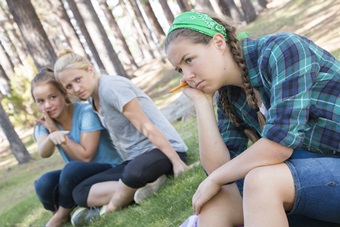 Peer cruelty is a problem and appears to be starting earlier. Though survey results do vary, by some estimates, one in seven American schoolchildren is either a bully or a victim. And the cruel behavior increases with age. A recent study prepared for the American Psychological Association showed that 80 percent of middle school students admitted to bullying behavior in the prior 30 days. The more we know about bullying, the better we will be able to parent our children.
So tune in closer to your child. Please. Repeated bullying causes severe emotional harm and erodes your child’s fragile self-esteem. Boys and girls are also bullied differently: girls are more likely to be victims of emotional and verbal bullying while boys are usually bullied by physical harm or threat. But whether the bullying was verbal, physical or relational, the long-term effects are equally harmful. Both boys and girls reported high levels of emotional distress and loneliness as well as lower self-esteem, loneliness, anxiety and depression.
Not all aggressive acts are bullying. Make sure you understand the definition.
If your child is bullied it means that peers are intentionally causing her pain. Bullying is repeated, conscious act of aggression with negative intent. There is also a power imbalance – the bullied child is targeted because they cannot hold their own.
Make no mistake: those cruel, aggressive habits are learned and should never be tolerated. Bullying also varies by ages and genders. What follows are the most common types of bullying and what it looks like by different ages and stages.
The Five Most Common Types of Bullying
There are five distinctly different types of bullying. A bully can “attack” her victim:
- Verbally (spreading rumors, saying prejudicial comments, delivering cruel remarks)
- Sexually (making sexual comments or gestures)
- Physically (hitting, slamming)
- Emotionally (excluding, humiliating, threatening, extortion, hazing)
- Electronically (cell phone, text-messaging, email or website).
Bullying by Stages and Ages
Bullying also takes on different forms at different ages. Here is what bullying looks like during the preschoolers years, school age and preteen/teens years. Of course, nothing is set in stone so your child’s experiences may differ but here are typical expectations:
1. Bullying During Preschool
These are the ages bullying behaviors are first learned because kids learn it works to get their way. Beware, new studies are showing that bullying is starting much earlier (20 percent of kindergardeners engage in bullying; an Australian study found 3 and 4 year olds engaging in peer cruelty). Little ones are imitators — watch what they imitate and stop it, ASAP! In the young set:
- Bullying is mostly physical (biting, pinching, kicking, or shoving) and usually not intentional(the true definition of bullying).
- Aggression is mostly due to impulsivity and the inability to regulate emotions. Do not allow aggressive behaviors or cruelty in any form. They easily become habits.
2. Bullying During School Age
- Verbal bullying (saying mean comments, put downs and taunts) is prevalent.
- Physical bullying continues with younger school age students.
- Around fourth grade social exclusion (leaving kids out and knowingly hurting their feelings) begins.
3. Bullying During Preteens and Teens
Bullying peaks during these years-especially during the tween years-and is also the most vicious. Average middle school student experiences at least one verbal harassment per day. Though adults big concerns generally regard cyberbullying, research shows that most bullying starts face to face. By nature, bullying is a problem with dysfunctional relationships. The most common types of bullying (though not limited to these) are:
- Relational aggression, rumor spreading and emotional bullying are common amongst girls.
- Electronic bullying (via text, IM, pagers, cell phones, websites, Facebook, and emails) also begins.
- Bullying turns to sexual harassment. Forty percent of fifth through either graders say they’ve been sexually harassed by peers (mostly boys).
While you can’t always be there to step in and protect your child there are ways to help your son or daughter be less likely to be victimized in the first place. Your first step is to get educated! A search in my blog will reap dozens of other articles on bullying. I am currently writing a book, The Complete Educator Guide for Bullying Prevention that will be available from Free Spirit Publications in Spring 2016.
***************************************************************************************************************
Dr Borba’s book The Big Book of Parenting Solutions: 101 Answers to Your Everyday Challenges and Wildest Worries, is one of the most comprehensive parenting book for kids 3 to 13. This down-to-earth guide offers advice for dealing with children’s difficult behavior and hot button issues including biting, tantrums, cheating, bad friends, inappropriate clothing, sex, drugs, peer pressure and much more. Each of the 101 challenging parenting issues includes specific step-by-step solutions and practical advice that is age appropriate based on the latest research. The Big Book of Parenting Solutions is available at amazon.com

