
Kids Can Fidget in a Vidget: Seats that Inspire Natural Movement
Last updated on September 14th, 2024 at 09:05 pm
Healthy movemen t. Healthy learning. Healthy minds. Healthy spaces.
As I explored many different topics for my MFA Thesis in Industrial Design at RIT back in 2009, my mind and soul kept taking me back to my childhood experiences and how connected I was to the mystery of nature. Living in a rental property in an urban area, I didn’t grow up around fields of green grass but what I did have, I treasured. My backyard was cement but in the front of our house, there was a narrow bed of dirt with bushes, probably about 3 feet wide. This narrow bed of dirt became my haven for exploration and inspiration. As I explored my feelings of nature, I was directed by one of my advisors to read the book, Last Child in the Woods, by Richard Louv.
While in nature, Louv points out that children will “use more fantasy play, and their social standing became based less on physical abilities and more on language skills, creativity, and inventiveness” (Louv, 2008, p. 88). As I thought about this, I thought what better place to impact children than the classroom environment.
 Do you remember sitting in chairs like this as a child? When you look at this picture does it bring back memories of cold, hard and uncomfortable chairs that were too small or too large?
As a student, I remember feeling confined, trapped and limited. I had so many ideas, questions, and my imagination was wild, yet I was told to “sit down, be quiet and not to move.” I remember being very distracted, frustrated and, what teachers called back then, a “satisfactory & fidgety” student. Who wants to be “satisfactory? I wanted to be great, express myself and share my ideas and imagination; I instinctively needed to be creative, but the classroom demands took precedence over mine. I felt like I was different because my body needed to naturally move.
Not much has changed from this picture in today’s classrooms until recently. Reflecting on this time of my life, I remember wondering… could the classroom objects take on a “life” – that inspired natural movement we find in nature?
As part of my user research, I started observing classrooms from kindergarten – 6th. I found the teachers inviting and interested in my thesis topic, especially how to provide children with a way to move without too much disruption in class, finding that balance between control and natural movement. I observed classrooms using all traditional type chairs and alternative chairs that move like the exercise ball. While the ball provides proven benefits such as core muscle strengthening and better posture control, it is dangerous, disruptive and difficult for classroom management. Teachers were very reluctant to bring the ball into classrooms but at this time, it was the only “dynamic” seating device on the market.
 Research proves that sitting for more than 10 minutes at a stretch reduces our awareness of physical and emotional sensations and increases fatigue. Playing, running, jumping and feeling a sense of freedom is not only a desire but a human need.
When children are locked indoors all day within a controlled environment, stress and tension build, and learning suffers.
I wanted to provide a seating device that allowed kids to move but in a discreet way so that it didn’t stigmatize the child with special needs. ALL children need to move, but some kids with ADHD, Autism and Sensory Processing Disorder need more movement. I needed to design something for the inclusive classroom or environment as a way to allow for more integration.
In July 2010, the Division of Adolescent and School Health at the U.S. Department of Health and Human Services issued a research report, The association between school based physical activity, including physical education, and academic performance, to better understand the changing needs of students and teachers. Children’s’ bodies are meant to move, even if it is just standing.
As the ideas for the Vidget® started to take shape, I decided on the following design elements:
- children feel safe to be free & explore (both physically and cognitively safe)
- modular system that inspires natural movement.
- fun yet functional with many possibilities
- reduce feeling of confinement
- inspire children & teachers to build their own environment based on individual and group changing needs
- simple, inviting, flexible, and intuitive
- organic, flowing
 I used clay as a way to start building the form of the Vidget®.
As I played with the shape, I had the “aha” moment that if the bottom surface could be shaped like an arc, it would rock side-to-side, similar to the stability ball. I turned it over and realized the cut-out for the feet could be used as a stool and turned the other way, the child could use it as a desk! Now I was on to something very special and it met my design elements – safety as the first goal!
After several more full scale models and user testing – taking about 3 years and additional design expertise – we finalized the dimensions of the 5 sizes (toddler – teen/adult). We took our prototypes and started sharing with local school districts and parents for feedback and more user testing, especially parents with special needs  children like ADHD and Autism who had a much higher sensory need. During this process, we learned that Special Education Teachers and Occupational Therapists put Velcro underneath tables and chairs for kids who have more sensory needs. We thought, how can we add this type of feature into the Vidget®? Another “aha” moment was to add recessed handles in the sides with sensory bumps on the top surface – kids fidgety fingers naturally find the bumps which provide a temporary sensory input some children need to promote calmness and focus.
I also wanted children to embrace the idea that a chair doesn’t have to be just a chair and inspire them to use their imagination. Parents and teachers are focused today on how to create “innovative thinkers” but they are still using the same old chairs and desks that are more of an obstacle vs. adding a benefit to the learning process.
In 2012, we were fortunate to meet the Chairman of our Board, Dick Kaplan, who invested in our company allowing the manufacturing of the Vidget® to begin. Since launching the design in 4th quarter 2015, we’ve sold more than 2,000 to parents, educators, health care providers and many more users across the country. We’ve attended 10 conferences in education and healthcare and received a number of positive reviews about how it is helping students in so many ways:
- “My oldest son is on the spectrum (ASD, high functioning) and has ADHD. The rocking feature helps him stay seated but allows him to rock & move when needed. His OT even ordered two for her office! Great product!”
Trisha, Mom - “Since incorporating the Vidget in our classroom, I have noticed an improvement in attention span, participation, and regulation in my students. They are happy and engaging in classroom routines and activities. The Vidget’s bright colors make it fun and attractive to use, and the kids love the versatility of the seat.”
Tara, PreK Teacher & Occupational Therapist - “After only having the Vidget chairs in my room for less than a week, I have observed a noticeable increase in on-task behavior from students who use them. Students who sit in the chairs participate more and demonstrate greater self-management. I am extremely excited and grateful to have these “tools” as part of my classroom.”
Dan, 6th Grade Teacher (integrated classroom)
 Fidgeting improves focus, releases energy, and promotes calmness. Vidgets create a healthier environment by providing a safe and quiet way to release some of the endless energy kids, teens, and adults have. Teachers who have incorporated flexible seating in their classrooms have noticed positive results such as longer attention spans, less disruptive behavior, and higher quality work. And for special needs, fidgeting and movement helps children with ADHD focus and problem solve. So rather than tell students to sit still, teachers are encouraging quiet fidgeting to help students learn.
With the Vidget®, we are not just moving our bodies, we are changing the way we look at the learning environment. Creating healthy and flexible spaces that inspire collaboration, creative and critical thinking, is what builds innovative spirits and ideas. The Vidget® is just one tool that helps in the process.
HEALTHFUL HINTS:
- If you are looking at seating devices that move for your special needs child, consider your child’s typical movement needs and ask the following questions: (Note: there are several seating options that provide movement, some with a lot of movement and others with less; Wobble Seat, Stability Ball, ergoErgo, and Vidget).
- Does my child require sensory input
- Does my child have issues with tipping back in their chair
- Does my child benefit from being allowed to move naturally
- Does my child have balance or mobility challenges
- If you are purchasing a seating device for a school environment:
- Consider getting a couple different models to try. For schools, we encourage a universal design approach by offering several options to let the student decide based on needs.
- When having students choose their seats, be sure that legs are 90 degrees when seated and feet are flat on the ground. It’s estimated that 83% of students are sitting in chairs that are not the correct height leading to increased fatigue, poor posture, and loss of attention.
- When possible, have different sizes in the classroom to accommodate all students as they grow throughout the year.
Should Your Child Take The New Fidget Toy Out For A Spin?
Last updated on May 29th, 2017 at 11:28 am
 Fidget toys called Spinners have become a huge fad for kids. They all seem to love them. Meanwhile, most teachers and parents seem to hate them. In fact, Spinners are being banned in many schools. Some kids are crushed and some parents are furious. Where do you stand? Let’s take a look at Spinners and fidget toys in general and see if we can figure out this issue.
Old school types usually say, “Why are kids being allowed to bring toys to school these days? Why can’t they just sit still?” Here’s the thing – kids have always needed to fidget. They have been tapping pencils, wiggling their feet, chewing their nails, drawing on notebooks and countless other things since formal schooling began. Some of this behavior is expected by teachers, and they know how to manage it in their classrooms. But for some kids, movement is imperative.
Kids who have learning disabilities, or are on the autism spectrum, or have other challenges really DO need to move. It’s not that they are being disruptive, it’s just the way they are wired. Some schools today are getting rid of recess and PE, leaving these kids even less opportunity to be physically active during their day. This leaves kids with even more need to fidget.
Enter the fidget toy. A true fidget is not really a toy but more of a therapeutic tool. The first one I ever saw was an elastic band that was tied across the legs of a desk or a chair and the student could bounce their legs on the band. Some fidgets are much less physically active – putty has been gaining ground in classrooms lately. Rubik’s Cube is a classic example of a fidget for the hands, but it can be loud and distracting to the other students. Fidgets don’t all have to have a solution or an endpoint. Putty can be sculpted into something, but it can also be simply manipulated for the sensory input. In a classroom with an inclusive population, where some kids have special needs and some are “typical” as the term goes, can you allow some students to have these items and say no to the others? This creates even more issues in a classroom.
 Enter the Spinner. They come in many colors and materials, and some even light up. They are very well named – they spin. That’s all they do. Some have one circle, others have three, and you can move the spinning bearing to change the motion and the sensation.
All people are drawn to spinning items, this is why there is a now a job called sign spinner, why children have played with spinning tops all throughout history and why pinwheels and whirligigs have been popular since they were invented in China in 400 BC (yes, I did my research). People on the autism spectrum are especially drawn to spinning items, so I could see Spinners calming a tantrum (I work with special needs kids and know first hand that tantrums don’t only happen to toddlers). But in reality they are just being used to show off the latest color or model and taunt the kids who don’t have them. They are also being used as weapons, to poke or spin on someone else’s skin. Eventually they will end up being thrown at someone. They do sort of look like Ninja stars, and many manufacturers have Ninja Star Spinners so clearly I am not the only one who made the connection – and some of those types look very sharp!
To see what all the hype is about I played with one. The key word is PLAYED – it is certainly a toy. If you change the heavy part to one of the outer rings it does have an interesting weighed effect, but I really only see the benefits for kids with special needs and/or sensory issues. I think Spinners would be useful for kids who stim, not necessarily for kids who fidget. You can find a good Spinner for that here.
Self-stimulatory behavior, also known as stimming and self-stimulation, is the repetition of physical movements, sounds, or repetitive movement of objects common in individuals with developmental disabilities, but most prevalent in people with autism spectrum disorders. It is considered a way in which autistic people calm and stimulate themselves. Another theory is that stimming is a way to relieve anxiety, and other emotions. Common stimming behaviors (sometimes called stims) include repeating noises or words and spinning objects. …Wikipedia
A compromise might be to establish rules for when, where and how Spinners may be used. Parents and/or teachers could brainstorm some rules as well as consequences. Maybe they can be used at recess but not in the classroom, or maybe if the class finishes the day’s lesson plan early they would be given some time at the end of class to bring out their Spinners, which might even encourage better classroom behavior. Perhaps they could be attached to the underside of desks so they can be spun out of sight.
While doing research I also found some Youtube videos that teach Spinner tricks which might get the kids up and active trying to balance, toss and catch the toy. There are also instructions for making your own Spinners, so break out the craft supplies and turn off the video games!
Parents Share Their Tips for Helping Kids with Homework
Last updated on March 26th, 2017 at 11:45 pm
Homework is an important part of your child’s education and as a parent you can take steps to help them to get the most from it.
Managing homework can be a source of tension. Three parents share the tips that helped them.
Turn Off the TV During Homework
 “The best thing I’ve ever done is ban all screen time on the TV and computer from Monday to Thursday,” says Patricia, 39, mum to two boys aged 8 and 12.
“Before I did this, my younger son would always be creeping off to watch cartoons. Now that’s not an option, it’s much easier to get homework done. Interestingly, his headmistress thinks that’s the best policy, too. She often sees a big improvement in overall mood and performance in children who have this partial ban.”
Don’t Help Your Children with Homework
“They’re not being marked on what you can do,” says Linda, 39, mum to twin eight-year-old girls. “I know people who virtually do their children’s homework for them, but what’s the point in that? It’s not a competition.”
Dr Susan Hallam of the Institute of Education also advises that you offer moral support, but only give help when your child asks for it.
Do Homework While Your Child’s Alert
“The golden rule with a seven-year-old is to get it done as soon as you get in from school, before tea (*dinner),” says Michael, who has a seven-year-old daughter. “The attention span deteriorates pretty quickly after tea for anything other than Barbie websites.”
Patricia agrees. “Some kids need a little downtime immediately after getting home from school, but if you leave it too late, they’ll be too tired to concentrate.”
Homework Tip: Use a Timer
“If you have one of those children who endlessly dawdle over homework, sharpening all their pencils, getting up and down or reading all their previous homework, it can sometimes help to set a timer,” says Patricia.
“If the school recommends 20 minutes a night, then set the timer for 20 minutes and say that’s the limit. This can sometimes backfire and result in hysteria though, so play it by ear.”
Let Children Know You’re on Their Side
“I find that if they’re complaining bitterly, it can help to sympathise with them,” says Patricia. “I do genuinely feel for them over homework and it does help them to know I’m on their side. But at the same time I feel I need to insist on it being done, so it’s a balancing act.”
Editor’s Note: *clarification provided for our US readers.


Want Kinder Kids? 6 Simple Ways Kids Can Practice at School
Last updated on May 28th, 2017 at 12:00 am
 Practicing kindness is what helps children tune into other people’s feelings and needs, trust more, step out of their own skins to understand others, and become UnSelfies (my term for kids who are “more we, less me” oriented). Each kind act nudges kids to notice others (“I see how you feel”), care (“I’m concerned about you”), empathize (“I feel with you”) and help and comfort (“Let me ease your pain”).
Helping students practice kindness also activates empathy and creates more caring schools. That’s why I consider “Practicing Kindness” as an essential habit of empathy.
Over the last years, I’ve observed countless classrooms around the world as I researched ways to nurture children’s empathy and reduce bullying. Here are a few favorite ways educators help students practice kindness and acquire empathy from my book, UnSelfie: Why Empathetic Kids Succeed in Our All-About-Me World. The book includes over 300 practical ways based on the latest science, and none cost a dime, and are simple to implement.
1. “High Five” Hallways
 A group of elementary Wisconsin teachers recognized that their hallways were always crowded and didn’t have that warm “feel tone.” But students had an idea to create a more caring climate: “Everybody can give ‘High Fives’ as they walk to class!” And that’s exactly what students now do (as well as teachers, the principal, and any guest). Not only is the school tone friendlier, but students are practicing social emotional skills like eye contact, giving encouragement and saying kind comments.
School hallways are usually congregated areas and notorious “hot spots” for bullying. But just by having students deliberately acknowledge one another in friendly, caring ways, bullying can be reduced and kindness can be the new norm. And everyone seems to be wearing bigger smiles.
2. Sidewalk Chalk Artists
Want a simple way to brighten up your school and spread kindness? Purchase large quantities of colored sidewalk chalk! Start by forming small student teams who will decide what kind messages they want to spread to others. (Ideas must 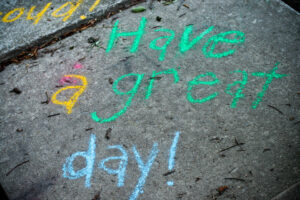 be approved by the teacher).
Then each team or class draws their kind, friendly messages on approved school-ground spots such as asphalt, sidewalks or playgrounds. It’s a colorful way to brighten your school grounds while kids practice kindness and collaboration.
And don’t overlook teens! I recently visited St. Francis High School in the Bay Area and noticed that their sidewalks were decorated with student-drawn inspirational kindness quotes.
3. Student Greeters
Clover Park School District in Washington recognized an untapped talent: students with strong social emotional skills who could serve as models to other students. And every school has friendly, kind kids whose skill set can be a powerful model for peers to copy. The staff identified these students and asked them to serve as student greeters. They wore red baseball caps so they were easily identified (other schools have made special vests). Greeters were stationed at the front door and welcomed entering students (“Hi!” “Glad you’re here!” “Have a good day.”) The staff reported a positive change in climate in just a short while. Students began to look forward to the greeting. And many arriving students began to return the same positive statements to the greeters.
4. Student Welcome Wagons
New kids can feel the pain of exclusion. So why not initiate a “Welcome Wagon Committee” of students to greet newcomers, give them a school tour, and pair them with “veteran” students. Photos of new arrivals can be featured on a faculty bulletin board to alert staff members of these students. Some schools with highly mobile populations arrange “get acquainted” sessions with new students where they learn about their school, connect with others, and practice kindness.
5. Cross-Age Buddies
This approach has been effective in boosting academic achievement and creating positive student connections. Student helpers are typically two to three grade levels ahead of the peers they tutor. Not only can they tutor students on academic tasks, but they can also teach the SEL skills to their younger buddy. And the experience can help build empathy, especially if the tutor assumes the role of a big brother or sister to a younger “buddy.” What’s more, the big buddy can begin to reframe his image and see himself as a caring person.
6. Learning Buddies
This idea was shared by a Vancouver teacher who assigned each student to be the learning buddy of another student in the classroom every week or month. Students pair up with their partners a few minutes a day. The strategy builds connections, enhances achievement and opens empathy. A few ideas:
- Students quickly turn to their buddies and agree on the task directions before they work on the task alone.
- Buddies discuss three main points from their homework assignment or from the task they just completed.
- The buddy calls or emails an absent partner to say: “We miss you,” provides missed assignments, or makes a get-well card with class signatures.
Or students (teachers, principals, bus drivers, cafeteria workers, yard supervisors, counselors, nurses, psychologists) can just take a moment to welcome and encourage one another. It’s also wonderful way to nurture students’ empathy and practice kindness.
There are countless ways for students to practice kindness and increase their empathy capacities. But look for real, meaningful, face-to-face type experiences. Those are the kinds of opportunities our students need to develop caring mindsets and become caring, socially responsible, good people.
**************************************************************************************************************************
 Teens today are 40 percent less empathetic than they were thirty years ago. Why is a lack of empathy—along with the self-absorption epidemic Dr. Michele Borba calls the Selfie Syndrome—so dangerous? First, it hurts kids’ academic performance and leads to bullying behaviors. Also, it correlates with more cheating and less resilience. And once children grow up, it hampers their ability to collaborate, innovate and problem-solve—all must-have skills for the global economy. The good news? Empathy is a trait that can be taught and nurtured. UnSelfie is a blueprint for parents and educators who want activate our children’s hearts and shift their focus from I, me, and mine… to we, us, and ours. It’s time to include “empathy” in our parenting and teaching! UnSelfie is AVAILABLE NOW at amazon.com.
How to Help Your Child Overcome Exam Stress for Good
Last updated on December 12th, 2016 at 03:09 pm
Good planning and a realistic revision (*study) schedule can turn a heavy workload into something manageable. And knowing you have a schedule can help you manage your nerves.
It’s Wise to Revise

It sounds obvious, but revision (*studying) really is the key to exam success. Being fully prepared for your exams is the most effective way to overcome stress and anxiety, and gives you the best chance of getting the best grades you can.
Before you start revising, the amount of work you have to do might seem overwhelming. Many exam timetables require you to study for lots of different subjects at once, and it’s easy to feel daunted.
Deal with this by making a revision (*study) schedule you can stick to. Work out how much you have to do and the time you have to do it in, then break it down into chunks. Allocate yourself a few hours of revision a day, and mix up your subjects so that you don’t get bored.
It’s also important to find a revision style that suits you. Studying alone in a quiet room suits many people, but not everyone likes working in silence. Try playing music quietly in the background, or revising (*studying) with a friend (but don’t let them distract you).
You could customise your notes to make them more personal. Experiment with colour coding, note cards, diagrams or whatever helps you learn your topic.
If you come across something you don’t understand, try to find a new source of information rather than just memorising it, as this won’t help you in your exam. Don’t be afraid to ask your teacher or a friend for help if you need it.
Looking at past exam papers can also be useful, as you can familiarise yourself with the layout and type of questions you’ll be asked. Practise completing the exam paper in the set time limit so you know what you need to do to improve your exam technique.
Rest and Relaxation
Revision (*studying) is an essential part of exam success, but it’s also important that you don’t overdo it. Studying for hours and hours without a break will only make you tired and ruin your concentration, which may make you even more anxious.
Stress is a natural feeling that’s designed to help us cope in difficult situations. In small amounts, it’s good for you because it pushes you to work hard and do your very best.
However, too much stress can cause problems such as headaches and loss of appetite, and can make you bad tempered. Avoid excess stress by taking frequent short breaks while you’re working. A break every 45-60 minutes is about right.
During your breaks, do something relaxing, such as reading a book or going for a short walk. Taking your mind off your work will help you come back to it feeling refreshed. It can also help if you reward yourself after each revision (*study) session. For example, with a long bath or a good DVD.
When you’re not revising (*studying), use your spare time to get away from your books and do something physical. Exercise is good for taking your mind off stress and keeping you positive, and it will help you sleep better.
If you’re still feeling stressed, it’s important to talk to someone you trust, such as a family member, teacher or a friend. Many people find exams difficult to deal with, so don’t be embarrassed to ask for support.
On the Day
It’s natural to be nervous on the day of your exam, but don’t let your nerves take over. Start the day with a good breakfast, and give yourself plenty of time to get to the exam hall. Remember to take everything you need, including pencils, pens and a calculator. A bottle of water and some tissues are also useful.
Once the exam has started, take a few minutes to read the instructions and questions so you know exactly what’s expected of you. Ask an exam supervisor if anything is unclear; they’re there to help you.
Plan how much time you’ll need for each question. Don’t panic if you get stuck on a question, but try to leave yourself enough time at the end to come back to it. Even if you’re really stumped, an educated guess is better than leaving it blank.
When the exam is over, don’t spend too much time going over it in your head or worrying about it. Resist the temptation to compare your answers with those of your friends. If you have more exams to come, focus on the next one instead.
Editor’s Note: *clarification provided for our US readers.
How Much Homework is Healthy: a Pediatrician’s Perspective
Last updated on March 2nd, 2018 at 12:17 pm
 Home work for children is considered a benefit by some and an albatross to bear by others with no good studies showing that it is beneficial to children or their grades. The amount of homework children get now appears to be excessive by parents and children alike, and is often the source of interpersonal problems and stress within an individual family unit.
Some studies have indeed found that the amount of homework that children receive is excessive and unrelated to a child’s age or abilities. A National Educational Association has established what they refer to as “the rule of 10s”, wherein the length of time that a child spends on homework should be no more than 10 minutes per night for each grade level of school, and none for Kindergarten. Therefore a first grader should get about 10 minutes a night, second grader 20 minutes a night all the way up to a 12th grader at 120 minutes per night. When the same group studied the amount of homework that children actually receive today, they found that it was two to three times that amount. If any of you have tried to keep a 5 or 6 year old sitting in one place for 20 to 30 minutes it becomes obvious that the standards need to be looked at very closely and probably revised.
It has also been found that the younger the child the less impact homework had on their grades or school performance. Conversely, the older child showed the amount of homework was definitely related to an improvement in the parameters mentioned above (within reason).
Life has become very active and full for children of all school ages to the point that there is practically no time for being a child: running around outdoors, keeping busy getting exercise, relating to other children and doing things that we all did and enjoyed when we were younger. Both children and their parents are responsible for this behavior as parents are pushing and children are striving for higher and higher goals. This is not to specifically to point a guilty finger at anyone but merely a reminder about what really is important in life and grades will not necessarily make a lasting difference in the future of your child.
So try to objectively evaluate your own child in terms of abilities, needs and the need and importance of non-scholastic activities for your child. Also evaluate the health of your family to determine if mood is related to the homework experience- if so find a way to decrease the stress, and understand your child does have limits.

